


The Th12 Vertebra: Your Foundation for Stability
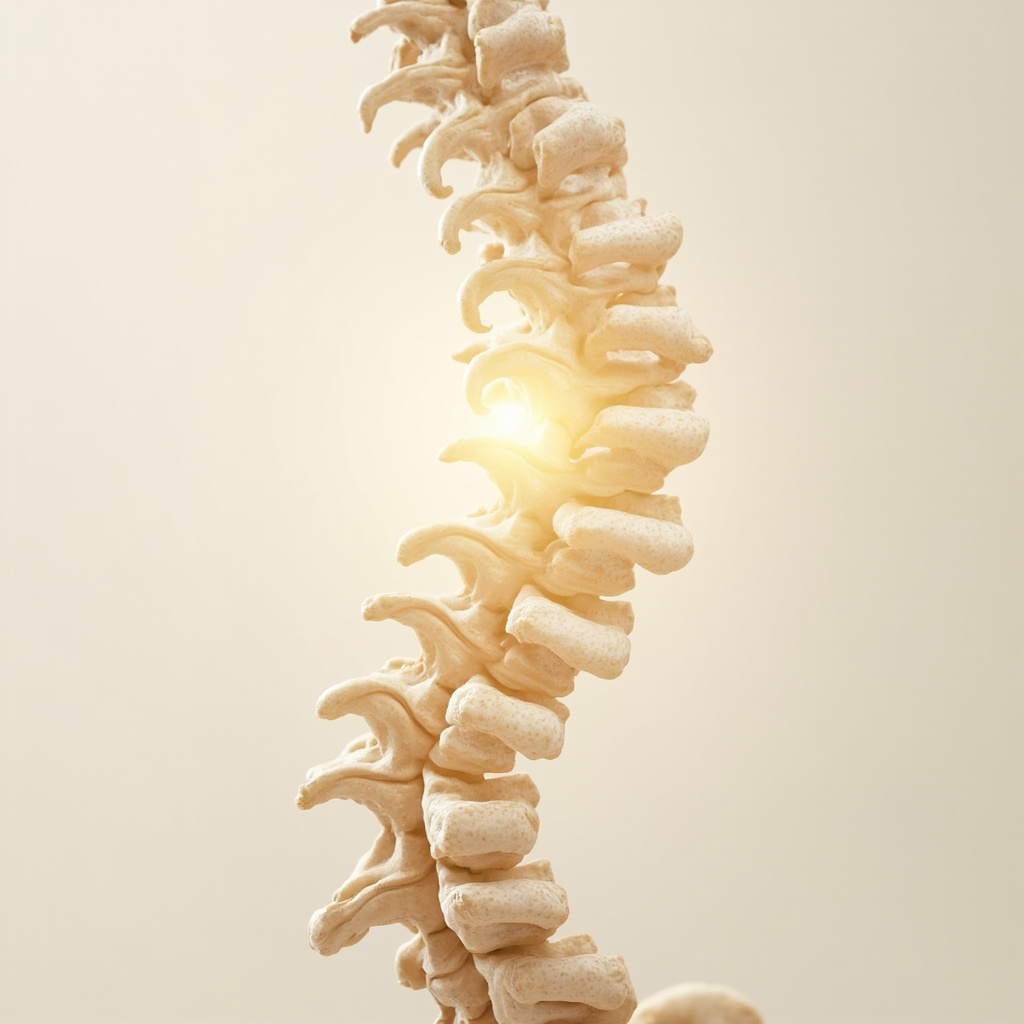
As a fitness coach, I spend a lot of time looking at how the body moves and, more importantly, what supports that movement. We often focus on big muscle groups like the quads or the lats, but the true secret to resilience and performance often lies in the small, structural pivots of the spine. Today, I want to talk about a specific anchor point that I frequently monitor in my practice: the Th12 vertebra.
The Gateway Between Upper and Lower
Located at the base of your ribcage, just where your thoracic spine transitions into your lumbar spine, the Th12 is a critical junction. Think of it as the gatekeeper of your torso. It is the last of the thoracic vertebrae, meaning it carries the weight of your upper body and needs to remain flexible enough to allow for rotation, yet stable enough to protect the spinal cord and support your posture.
When I analyze biomarkers, I often look for signs of tension in this area. Because it sits at this transition point, it is incredibly sensitive to how we carry ourselves. If your posture is slouched or if you are overtraining without enough recovery, this specific vertebra often becomes a site of hidden fatigue. When it struggles, you might feel it as a dull ache in the mid-back, a sense of stiffness, or even a feeling that you cannot quite 'find your center' during a workout.
More Than Just Bone
What makes the Th12 truly fascinating is how it echoes our emotional state. In my experience working with athletes and individuals seeking balance, physical tension in this region is rarely just about a tight muscle. It is intimately connected to our sense of stability and security.
This area is structurally close to your adrenal glands, the organs responsible for managing your stress response. When you feel overwhelmed, insecure, or like you are losing control of your territory-whether that is at work, at home, or in your fitness routine-the body often braces itself. This 'bracing' manifests as tension around the Th12. It is as if the body is physically trying to hold itself together when it feels mentally unsupported.
Finding Your Natural Balance
Understanding your Th12 as a resource rather than just a weak point can change how you approach your training. When we view this vertebra as a source of strength, we stop fighting against the discomfort and start using it to anchor our movement.
If you find that your energy is flagging or your recovery is slower than expected, it might be time to check in with this area. I often suggest focusing on gentle, intentional movement that encourages the spine to lengthen. By directing your attention to the Th12, you can begin to release the defensive tension held there. This allows your nervous system to shift from a state of 'survival' or 'protection' into a state of 'flow' and 'recovery'.
How to Support Your Th12
You do not need to be an expert to start supporting this part of your body. Simple, conscious breathing is one of the most effective ways to influence the spine. When you breathe deeply into the lower ribcage, you are essentially providing a gentle, internal massage to the Th12 area.
In my practice, we use specific resonance frequencies to help the body 'remember' how to relax and stabilize this area. Whether through a Harmonic Boost to help the structure resonate with calm, or a Personal Guide session that focuses on the emotional aspects of security and support, the goal is always the same: to help you regain your natural, upright confidence.
Remember, your body is a system of interconnected parts. When you take the time to nurture a small but vital structure like the Th12, you are not just fixing a sore back. You are building a stronger, more resilient foundation for everything you do.
Related posts
Glossary
- Energy and mind Structures > Focused Coherence; Focus
- Energy and mind Structures > Structure
- Energy and mind Structures > Security
- Energy and mind Structures > Confidence
- Energy and mind Structures > Relax
- Body zones > glands
- Body zones > Th12
- Body zones > Vertebrae
- Energy and mind Structures > Organs
- Energy and mind Structures > movement
- Energy and mind Structures > Stress
- Stimuli > Moon - Nasal Passage, Breathing, Taste
- Binaural beats > Spinal Cord Support: Enhance Wellness and Emotional Balance
- Binaural beats > Nervous System: A Program for Emotional Balance and Relaxation