


Ascaris Larvae: Psyche's Gut Echo
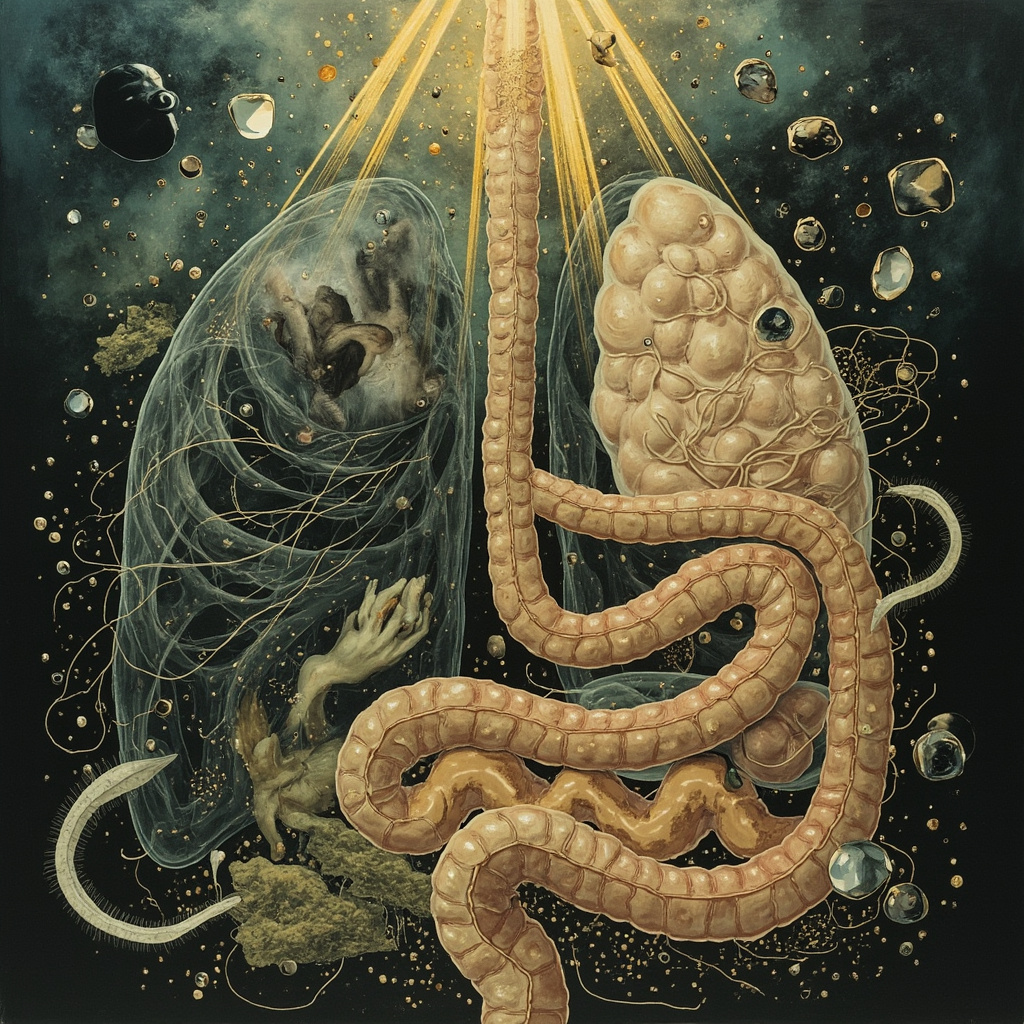
The Silent Migration Within
Ascaris larvae, tiny roundworm offspring, travel unseen through the body. They hatch in the intestines after eggs are swallowed, often from contaminated soil or food. These larvae burrow into the gut wall, enter the bloodstream, and journey to the lungs. There, they cause inflammation before being coughed up and swallowed again to mature in the gut. This cycle brings physical strain, but it also whispers of deeper psyche tensions. For more on this structure, see the glossary entry.
Physical Echoes of Invasion
The body reacts strongly to this intrusion:
- Gut distress: Abdominal pain, nausea, bloating, and diarrhea signal the larvae's passage. Blockages can occur if many gather.
- Lung involvement: As larvae migrate through the lungs, cough, wheezing, and shortness of breath arise. This phase, sometimes called Loeffler's syndrome, includes fever and fatigue.
- Long-term toll: Malnutrition, growth delays in children, and weakened immunity follow heavy infections.
These symptoms drain vitality, leaving one feeling vulnerable and exhausted. Recent studies highlight how such parasites contribute to broader health burdens worldwide.
Psyche's Mirror: Discomfort and Shadow
In Jungian terms, biomarkers like Ascaris larvae serve as mirrors of the unconscious. They reflect not just physical imbalance, but emotional undercurrents:
- Anxiety and unease: The constant migration evokes a sense of invasion, stirring restlessness and worry about bodily control.
- Disgust and fear: Knowing parasites dwell within can trigger revulsion, symbolizing rejected aspects of the self-the shadow.
- Distress and fatigue: Physical weariness amplifies emotional lows, linking to suppressed tensions or unresolved conflicts.
Research shows parasitic infections correlate with higher rates of anxiety, depression, and neurotic traits. Children may show psychomotor issues, while adults experience mood shifts. This is no coincidence; the body amplifies psyche's unresolved echoes.
When the Larvae Speak of Trauma
Consider the individuation process, Jung's path to wholeness. Larvae biomarkers point to areas needing integration:
- Gut as emotional center: The intestines hold instincts and unprocessed feelings. Distress here mirrors inner turmoil from past wounds.
- Lungs as breath of life: Breathing carries spirit. Inflammation suggests stifled expression or grief trapped in the chest.
In therapy, we explore these through dream work. Dreams of worms or invasions often precede biomarker shifts, urging shadow work-facing the uncomfortable to reclaim power.
Turning Intrusion into Resource
Paradoxically, Ascaris larvae can become allies:
- Awareness guide: They highlight gut-lung connections, promoting holistic care.
- Emotional teacher: Symptoms invite reflection on discomfort, fostering resilience.
- Balance prompt: Tracking energy and agitation via biomarkers reveals patterns for inner harmony.
Practices like active imagination help. Visualize the larvae as messengers, dialoguing with them to uncover hidden capacities. As tensions ease, physical echoes fade, paving the way for renewal.
Pathways to Inner Harmony
Healing involves body and psyche:
- Hygiene to prevent reinfection.
- Nutritional support for recovery.
- Mindful practices: Meditation on breath and gut sensations.
- Journaling dreams tied to these symbols.
Biomarker trends show progress-reduced agitation signals integration. This journey transforms invasion into insight, aligning body, mind, and unconscious.
Through such mirrors, we step toward self-realization, embracing the whole self.
- 1. dash.harvard.edu
- 2. bio.tamu.edu
- 3. ncbi.nlm.nih.gov
- 4. naturedoc.com
- 5. yahoo.com
- 6. cdc.gov
- 7. pmc.ncbi.nlm.nih.gov
- 8. eurekalert.org
- 9. researchgate.net
- 10. refubium.fu-berlin.de
- 11. emedicine.medscape.com
- 12. bu.edu
- 13. tcd.ie
- 14. sciencedirect.com
- 15. emedicine.medscape.com
- 16. wcvm.usask.ca
- 17. pmc.ncbi.nlm.nih.gov
- 18. sciencedirect.com
- 19. authorea.com
- 20. swjpcc.com
- 21. nature.com
- 22. frontiersin.org
- 23. pmc.ncbi.nlm.nih.gov
- 24. nytimes.com
- 25. onlinelibrary.wiley.com
- 26. sciencedirect.com
- 27. researchgate.net
- 28. nature.com
- 29. my.clevelandclinic.org
- 30. nature.com
- 31. nation.steveharveyfm.com
- 32. mayoclinic.org
- 33. cureus.com
- 34. pmc.ncbi.nlm.nih.gov
- 35. facebook.com
- 36. facebook.com
- 37. dshs.texas.gov
Related posts
Glossary
- Energy and mind Structures > Structure
- Energy and mind Structures > Grief
- Energy and mind Structures > Immunity
- Energy and mind Structures > Ascaris larvae
- Body zones > lungs
- Body zones > chest
- TCM Recipes > Cough Relief: A Simple TCM Recipe for Chest Tightness
- TCM Recipes > Herbal Relief: A TCM Approach to Lift Your Mood
- TCM Recipes > Boost Your Energy: A TCM Recipe for Fatigue Relief
- TCM Recipes > Digestive Relief: Remedies for Abdominal Pain & Nausea
- Energy and mind Structures > vitality
- Energy and mind Structures > Theta; 4.31-6.97 Hz. Light sleep, meditation.
- Stimuli > IGF1, Growth
- Stimuli > Moon - Nasal Passage, Breathing, Taste
- Stimuli > Fever
- Stimuli > Pain
- Binaural beats > Inflammation Relief: Heal Faster with Binaural Beats
- Stimuli > Worms
- Stimuli > Parasites
- Stimuli > Harmony
see also...
- Energy and mind Structures > Theta; 4.31-6.97 Hz. Light sleep, meditation.
- Energy and mind Structures > Body zones > substantia nigra
- Energy and mind Structures > TCM Recipes > Digestive Relief: Remedies for Abdominal Pain & Nausea
- Testimonials > 61% Drop in Nausea and 58% in Headaches from Sound Therapy
- Binaural beats > Stimuli > Sacral, Zinc Etc
- Binaural beats > Desensitizer: Boost Your Energy and Focus Effectively