


Smooth Muscles: TCM Breath and Fear Ally
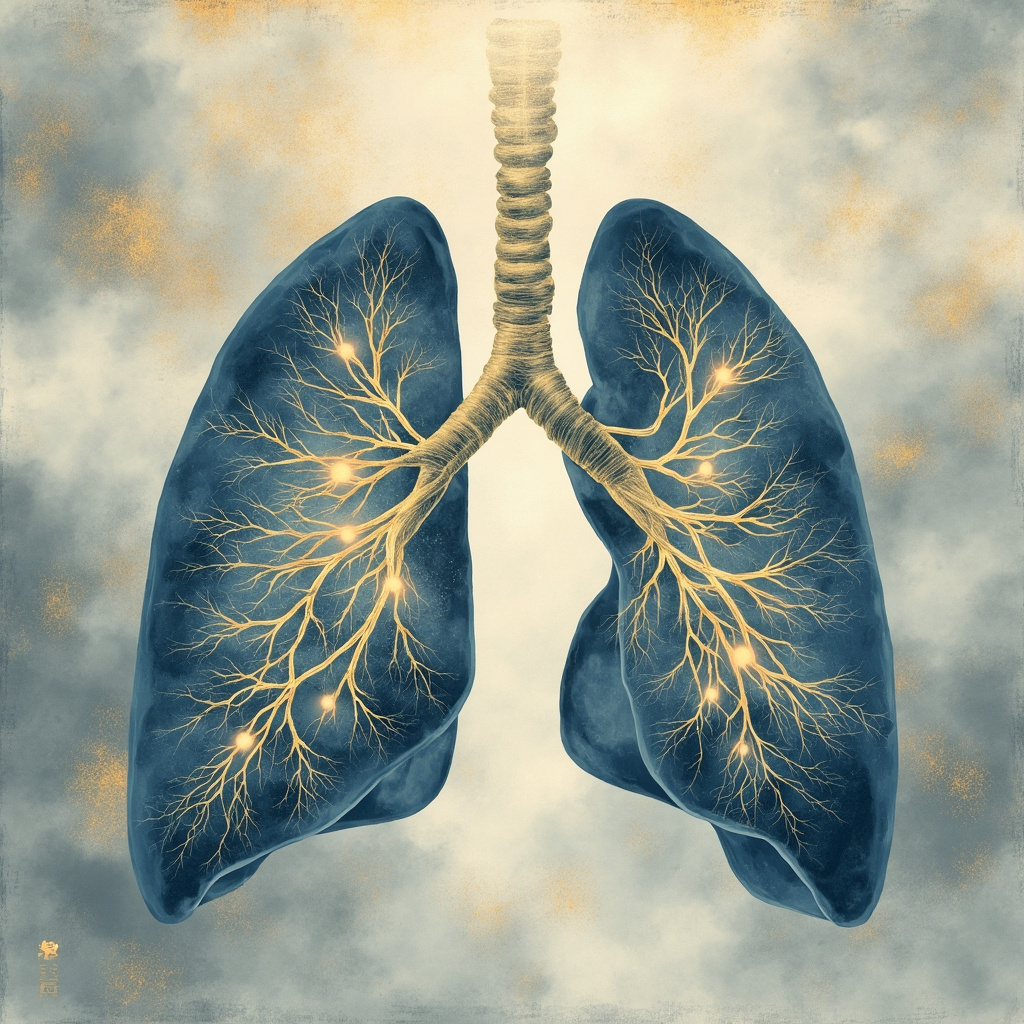
In our body's quiet workings, smooth muscles in the lungs and bronchi stand as gatekeepers of breath. These involuntary muscles line the airways, gently contracting and relaxing to adjust airflow. When balanced, they ensure every breath flows freely, delivering oxygen to nourish the whole body. For more details, see the smooth muscles glossary.
Their Key Role in Respiration
Smooth muscles help maintain open passages in the bronchi, the branching tubes of the lungs. Picture them as adjustable valves:
- Expanding airways during calm breaths for deep intake.
- Fine-tuning flow to match activity levels, like during exercise.
- Protecting lungs by filtering air and supporting steady rhythm.
Healthy function means effortless breathing, vitality, and clear energy circulation.
When Imbalance Strikes: Tight Airways
Under strain, these muscles over-contract, narrowing airways. This leads to shortness of breath, wheezing, and conditions like asthma. Physical triggers include allergens or cold air, but emotional ones play a big part too. Strong feelings like anger, fear, or even laughter can cause muscles to tighten up, speeding or shallowing breath, as noted by the Asthma and Allergy Foundation of America.
Recent studies echo this, showing stress activates brain pathways that heighten lung inflammation and sensitivity. In asthma, this creates a cycle: tension worsens symptoms, amplifying fear of attacks.
TCM Lens: Breath Meets Emotions
Traditional Chinese Medicine sees the lungs as the metal element organ, ruling qi descent and boundary protection. Smooth muscles embody this, safeguarding our 'territory'-personal space, survival, and security. Fear of threat, feeling trapped, or suffocated stirs subconscious alarms. These emotions stagnate lung qi, prompting muscles to constrict as defense.
Unlike skeletal muscles we control, smooth ones respond to deeper layers: meridians, yin-yang balance, and five elements harmony. Lung meridian blockages here mirror unprocessed fright, linking body tension to mind. Kidney's fear essence overlaps, as survival instincts grip the breath.
Smooth Muscles as Your Inner Ally
View them not as problems, but resources for healing. When called upon, they:
- Regulate airflow to ease stress-induced spasms.
- Open pathways for fresh qi, lifting emotional weight.
- Bolster respiratory resilience against fears.
In TCM practice:
- Breathing exercises: Slow diaphragmatic breaths descend lung qi, relaxing muscles.
- Acupressure: Press LU1 (middle palace) for lung opening, or LU5 (cubit marsh) to soothe spasms.
- Herbal support: Formulas like Ping Wei San clear damp stagnation; always consult a practitioner.
- Meditation: Visualize safe territories, releasing trapped feelings with each exhale.
BioCoherence insights reveal their energy, agitation, and emotional links through biomarkers. This guides precise harmony, aligning ancient wisdom with modern scans.
Bridging Ancient and New Knowledge
Modern research confirms TCM: stress-fueled brain signals inflame airways, mimicking qi blocks. Th17 pathways, primed by tension, resist calming treatments-much like excess heat defying cooling herbs. Emotional work breaks this loop.
Nurture your smooth muscles daily. Start with awareness: notice breath during stress. Gentle practices restore flow, turning vulnerability into strength. Balanced breath fosters not just lung health, but emotional freedom and life vitality.
Harmony awaits in every mindful inhale.
- 1. community.thriveglobal.com
- 2. explorationpub.com
- 3. youtube.com
- 4. mdpi.com
- 5. wavwatch.com
- 6. innersummits.ca
- 7. lung.org
- 8. pubmed.ncbi.nlm.nih.gov
- 9. pubmed.ncbi.nlm.nih.gov
- 10. everydayhealth.com
- 11. open.spotify.com
- 12. yourhealinginsight.com
- 13. pmc.ncbi.nlm.nih.gov
- 14. health.clevelandclinic.org
- 15. scitechdaily.com
- 16. pubmed.ncbi.nlm.nih.gov
- 17. pubmed.ncbi.nlm.nih.gov
- 18. pubmed.ncbi.nlm.nih.gov
- 19. the-scientist.com
- 20. pubmed.ncbi.nlm.nih.gov
- 21. parashospitals.com
- 22. sciencedirect.com
- 23. pubmed.ncbi.nlm.nih.gov
- 24. pubmed.ncbi.nlm.nih.gov
- 25. youtube.com
- 26. docwirenews.com
- 27. link.springer.com
- 28. aafa.org
- 29. pubmed.ncbi.nlm.nih.gov
- 30. healthcareoriginals.com
- 31. wavwatch.com
- 32. pubmed.ncbi.nlm.nih.gov
- 33. pubmed.ncbi.nlm.nih.gov
- 34. medicalxpress.com
- 35. news-medical.net
- 36. youtube.com
- 37. ncbi.nlm.nih.gov
- 38. emjreviews.com
Related posts
Glossary
- Energy and mind Structures > oxygen
- Energy and mind Structures > Security
- Energy and mind Structures > Meridians
- Body zones > lungs
- Body zones > smooth muscles
- Body zones > muscles
- Body zones > respiratory
- Energy and mind Structures > TH17
- TCM Recipes > Breathe Easy: Relief for Asthma Symptoms
- TCM Recipes > Allergy Relief: Natural Solutions for Respiratory Comfort
- TCM Recipes > Circulation: Boost Energy and Warm Your Extremities
- TCM Recipes > Lung Support: A TCM Recipe for Respiratory Health
- TCM Recipes > Brain Boost: Clear Fog, Improve Focus & Memory
- Energy and mind Structures > vitality
- Energy and mind Structures > Stress
- Stimuli > Moon - Nasal Passage, Breathing, Taste
- Binaural beats > Inflammation Relief: Heal Faster with Binaural Beats
- Stimuli > Harmony
see also...
- Energy and mind Structures > HRV
- Energy and mind Structures > Body zones > amino acids
- Energy and mind Structures > TCM Recipes > Boost Energy: A Simple Remedy for Low Energy and Fatigue
- Testimonials > 61% Drop in Nausea and 58% in Headaches from Sound Therapy
- Binaural beats > Stimuli > Sacral, Zinc Etc
- Binaural beats > Desensitizer: Boost Your Energy and Focus Effectively