


The Mediastinum: Your Inner Space for Calm
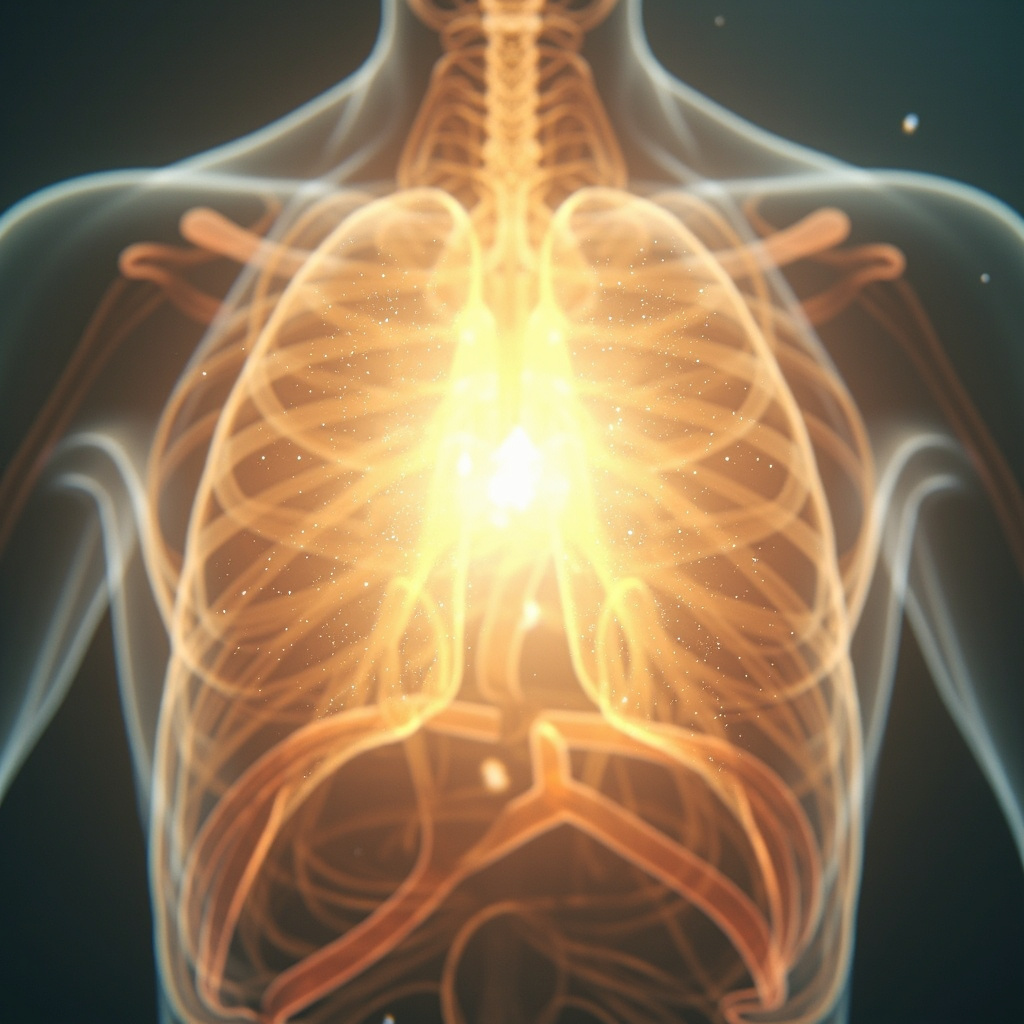
The Heart of Your Chest
When we talk about gut health and systemic balance, we often look at the digestive tract as the primary center of activity. However, our internal systems are deeply interconnected. Today, I want to shine a light on a vital but often overlooked area located right in the center of your chest: the mediastinum (you can read more about its anatomy here).
Think of the mediastinum as the central compartment of your thoracic cavity, tucked safely between your lungs. It is not just a physical space; it is a bustling hub that houses your heart, the trachea, the esophagus, and major blood vessels. It acts as a protective corridor that ensures your lungs, heart, and digestive pathways can function in harmony.
The Emotional Weight We Carry
In my work analyzing electrical biomarkers, I often see how physical tension in the chest correlates with emotional states. The mediastinum is uniquely sensitive to how we process our environment. Because it houses the organs responsible for breathing and blood flow, it often becomes a storage site for feelings of being overwhelmed, pressure, or a sense of being suffocated by daily responsibilities.
When you feel like you are trapped in a situation with no escape, or when you are carrying the weight of the world on your shoulders, this area can reflect that stress. This is where the gut-brain-heart connection becomes very real. If your body feels constrained, your digestion and your ability to process nutrients can also be affected by that underlying tension.
Finding Your Breathing Room
When we identify the mediastinum as a priority through electrical biomarker analysis, the goal is to restore a sense of spaciousness. We are not just looking at the physical organs; we are looking at the energetic flow that allows these systems to communicate.
By using targeted frequencies, we help the body release the sensation of being constricted. This can be incredibly supportive for those who deal with chronic stress or the feeling that their 'inner space' has been compromised. When this area is balanced, it acts as a powerful resource. It fosters better communication between your heart and lungs, which in turn helps calm the nervous system and supports your overall gut health.
How to Bring Balance Home
If you find yourself feeling tight in the chest or overwhelmed by your circumstances, consider these steps to support your internal harmony:
- Mindful Breathing: Focus on expanding your chest during inhalation. Imagine you are creating physical space in the center of your body, allowing the heart and lungs to move freely.
- Check Your Posture: Slouching can physically compress the mediastinal area. Gentle stretches that open the shoulders and chest can relieve the pressure on these vital structures.
- Emotional Release: Acknowledge the situations that make you feel 'trapped.' Sometimes, simply naming the stressor can reduce its hold on your physical body.
- Frequency Support: Through our platform, we can generate specific audio frequencies that resonate with this area, helping to shift the focus from constriction to expansion.
By nurturing this central compartment, you are doing more than just supporting your lungs or heart. You are reclaiming your sense of freedom and ensuring that your body has the space it needs to digest, recover, and thrive.
Related posts
Glossary
- Energy and mind Structures > Focused Coherence; Focus
- Energy and mind Structures > Communication
- Energy and mind Structures > Sensation
- Body zones > lungs
- Body zones > mediastinum
- Body zones > trachea
- Body zones > chest
- Body zones > digestive
- Energy and mind Structures > Organs
- Energy and mind Structures > Digestion
- Energy and mind Structures > Stress
- Stimuli > Hepatitis G virus, Primary
- Stimuli > Moon - Nasal Passage, Breathing, Taste
- Binaural beats > Nervous System: A Program for Emotional Balance and Relaxation
- Binaural beats > Blood Vessels & Arteries: Boost Circulation & Well-Being
- Stimuli > Harmony
- Stimuli > Blood
- Stimuli > Heart