


Body zones
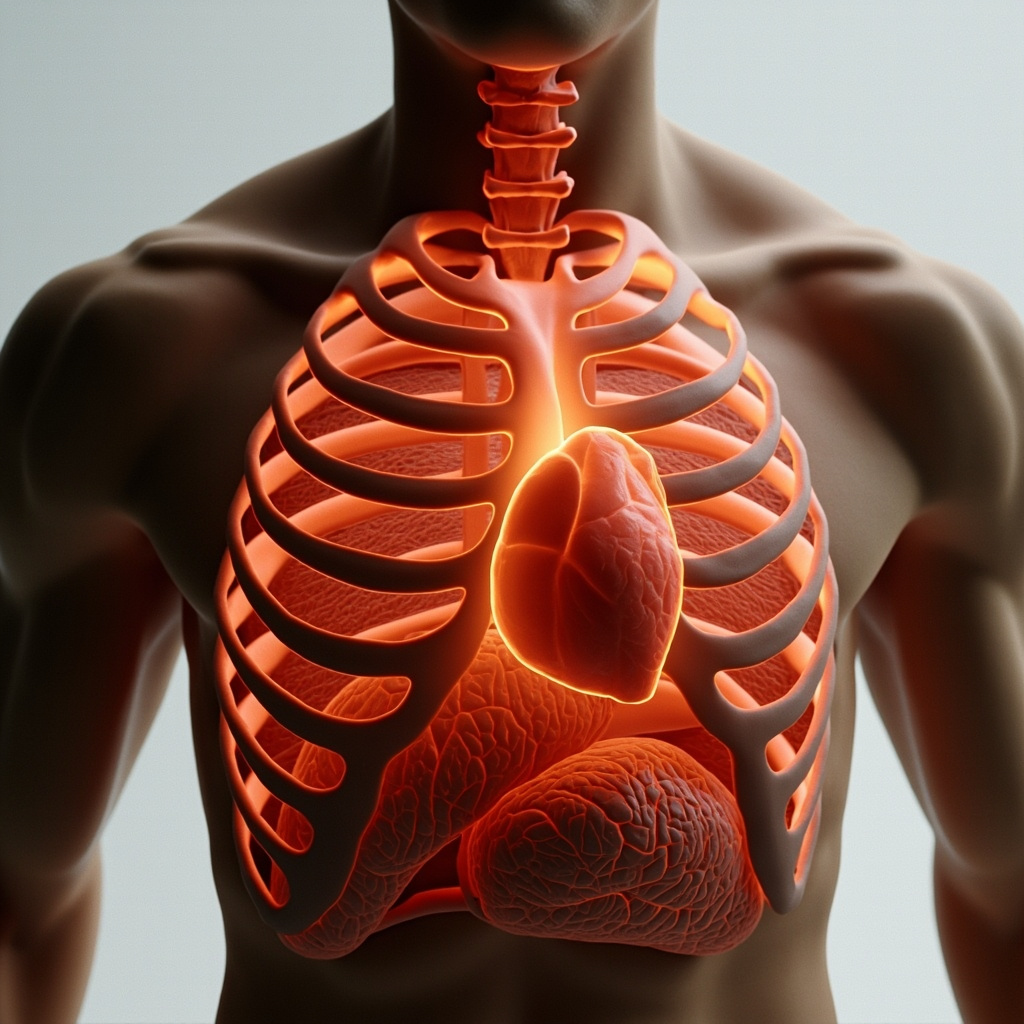
Chest: the front part of the torso containing organs
(chest)The chest is located between the neck and the abdomen, encompassing the thoracic cavity and the rib cage. It houses vital organs such as the heart and lungs. When functioning properly, the chest facilitates breathing, protects critical organs, and supports cardiovascular function. If malfunctioning, it can lead to respiratory issues, cardiovascular problems, and compromised organ protection, potentially resulting in severe health complications.
The chest can help other organs by ensuring efficient oxygen delivery to the body, supporting emotional well-being through the expression of love and vulnerability, and providing protection to vital organs, which in turn maintains overall health and balance.
The chest is often associated with feelings of vulnerability, love, and safety. Emotional conflicts linked to the chest may include issues related to self-protection, grief, and the ability to express or receive love. Malfunctions in this area could indicate unresolved emotional pain, fear of emotional hurt, or difficulties in personal relationships.
The chest serves as a vital anatomical region, housing the heart and lungs, which are crucial for respiration and circulation. Its primary functions include facilitating oxygen exchange, protecting essential organs, and supporting overall cardiovascular health. The chest interacts closely with the diaphragm and intercostal muscles to enable effective breathing, while also maintaining systemic connections with the circulatory system through the heart's pumping action. Additionally, the chest is linked to the emotional and energetic aspects of health, often embodying the capacity for love, vulnerability, and self-expression. Imbalances in this region can manifest not only as physical ailments but also as emotional distress, such as anxiety or grief, highlighting its role in our mental and emotional well-being. By promoting efficient oxygen delivery and protecting vital organs, a healthy chest supports energy, vitality, and resilience, ultimately contributing to a sense of well-being and balance. Understanding the chest's multifaceted role can empower individuals to address both their physical health and emotional challenges, fostering a holistic approach to wellness.
In BioCoherence, find the organ biomarkers and structures in Analyze > Body > Organs maps.
Posts from our community
- Why Esophagus Hurts Despite Diet & Antacids?
- Why Lung Mucosae Drain Energy Despite Diet?
- Sphincters Fail: Reflux Leaks Despite Diet?
- Why Stress Causes Stomach Pain Despite Diet?
- Why Fatigue & Anxiety Persist Despite Nutrition?
- Why UTIs & Lung Infections Persist Despite Antibiotics?
- Why Dandruff Persists Despite Shampoos?
- Why Hay Fever Ruins Sleep Despite Meds?
- Why Allergic Rhinitis Ruins Sleep Despite Meds?
- Why Sneezing Persists Despite Allergy Meds?
- Why Kid's Allergies Persist Despite Diet & Meds?
- Why do I have nasal congestion and insomnia?
- Why Hay Fever Ruins Sleep Despite Diet?
- Why do I feel emotionally vulnerable and chest tension?
- Pericardium Imbalance: Chest Pain Signs?
- Chest Lymphatic Imbalance: Fatigue Signs?
- Membranes Imbalance Signs: Fatigue Pain?
- I feel worthless and constantly exhausted due to a combination of factors such as stress, lack of sleep, mental health issues, or feelings of inadequacy. It's important to talk to someone who can help.
- Why am I always worrying? The hidden role of the spleen
- T6 Vertebra Pain: Mid-Back Ache Stress?
- High Stress Index HRV: Signs & Fixes?
- High VHF ECG: Nervousness Stress Signs?
- Bacillus Anthracis 2: Fear Anxiety Signs?
- Mycobacterium phlei: Lung Fatigue Signs?
- Coxsackie B1 Virus Heart Fatigue Signs?
- Capillaria Hepatica Liver Fatigue Signs?
- Fasciolopsis Cercariae: Liver Fatigue Anxiety Signs?
- Histomonas Meleagridis: Fatigue Gut Signs?
- Weak Thymus: Frequent Infections Signs?
- Why Weak Arteries Cause Fatigue No Joy?
- Why Coronary Arteries Cause Chest Pain No Joy?
- Why Left Arteries Cause Fatigue & Loneliness?
- Right Side Chest Pain Authority Stress?
- Why Poor Circulation Causes Fatigue & Stuck?
- Why Stress Ruins Blood Pressure Sympathetic Control?
- Why does the thoracic cavity cause chest grief and fear?
- Why Chest Tightness Signals Grief TCM?
- Why Stress Causes Acid Reflux Pain?
- Why Thymus Weakness Causes Infections & Fear?
- Why Does Emotional Hurt Weaken My Heart?
- Why does the AV Node cause fatigue, dizziness, and fear?
- Coronary Sinus: Heart Fatigue, No Joy?
- Why does a weak left atrium cause fatigue and fear?
- Why does a weak left ventricle cause fatigue and fear?
- Why Does My Chest Feel Tight and Anxious?
- Why Weak Pericardium Causes Anxiety Pain?
- Why Does My Chest Feel Heavy and Overwhelmed?
- Why does a weak right ventricle cause fear fatigue?
- Why Does Grief Tighten My Lungs?
- Why do weak alveoli cause breath fear and fatigue?
- Tight Bronchi: Space Conflicts Breathing Issues?
- Why do tight bronchi muscles cause asthma fear?
- Why Tight Bronchioles Cause Anxiety Breathlessness?
- Why Does My Chest Feel Tight and Suffocated?
- Why does the mediastinum cause fear of chest pressure?
- Why Lung Tissue Traps Grief TCM Symptoms?
- Why Grief Causes Shortness of Breath?
- Why Weak Membranes Cause Infections & Fatigue?
- Mucosae Issues: Infections, Dryness, Vulnerability?
- Why Grief Weakens Lungs TCM?
- Why Weak Bronchi Cause Cough Fear Fatigue?
- Tight Intercostals: Shallow Breath Anxiety?
- Why Weak Stomach Causes Worry & Bloating TCM?
- Why does weak parasympathetic activity cause stress fatigue?
- Why do spinal nerves cause organ pain fear?
- Why Weak Pericardium Causes Chest Pain Fear?
- Why Is My Breathing Tight with Grief?
- Why Lump in Throat from Stress & Emotions?
- Why Th5 Causes Back Pain Heartache?
- Why does Th6 cause back pain and chest worry?
- Why Poor Vascular Causes Fatigue No Joy?
- Why Weak Veins Cause No Joy TCM?
- Why Left Veins Cause Fatigue & Grief?
- Why Does My Upper Back Ache When I Feel Sad or Grieving?
- Why Grief Causes T4 Upper Back Pain?
- Why Worry Causes Stomach Pain & Bloating?
- Why Does My Heart Feel Heavy and Anxious?
- Weak pericardium can lead to anxiety in Traditional Chinese Medicine (TCM) because the pericardium is believed to protect the heart and regulate emotional well-being. When the pericardium is weak, it may fail to contain the heart's energy, resulting in emotional disturbances such as anxiety.
- Why do anger and frustration cause bloating and fatigue?
- Why Grief Causes Chest Tightness?
- Why Low AUC Causes Heart Fatigue Fear?
- Why High BPM Causes Fatigue Anxiety?
- Why Can't My Heart Adapt to Stress?
- How to heal a broken heart through energy and frequencies
- Why Heartbreak Causes Chest Pain & Fatigue?
- Why Weak Tarpaka Causes Brain Fog Mood Swings?
- Why Osmium Causes Fatigue Fear?
- Why Low Oxygen Causes Fatigue Brain Fog?
- Why Tin Imbalance Causes Fatigue Grief?
- Why does Actinomyces israelii cause pain, anxiety, and fatigue?
- Why Bacillus Anthracis causes fear and anxiety?
- Bacillus Anthracis 2: Fear Anxiety Weak Immunity?
- Why Haemophilus Influenzae Causes Cough Anxiety Fatigue?
- Why Klebsiella Causes Lung Anxiety Fatigue?
- Why Klebsiella Pneumoniae Causes Lung Anxiety Fatigue?
- Why Mycoplasma Causes Lung Fatigue Anxiety?
- Mycoplasma: Cough Anxiety Fatigue?
- Why Nocardia Asteroides Causes Lung Anxiety Fatigue?
- Why Pseudomonas Aeruginosa Causes Lung Anxiety Fatigue?
- Why do Rickettsiae cause fever, anxiety, and fear?
- Why does Coxsackie B1 cause heart pain fear?
- Why Flu Causes Anxiety Fatigue Irritability?
- Why Norovirus Causes Gut Pain Anxiety?
- Why does Besnoitia lung cause cough, anxiety, and fatigue?
- Fasciolopsis: Gut Pain Fatigue Anxiety?
- Hasstile sig.tricolor: Breathless Anxiety Fatigue?
- Why Myxosoma Causes Lung Anxiety Fatigue?
- Schistosoma Haematica: Gut Pain Liver Anxiety?
- Why Echinococcus granulosus Causes Liver Anxiety Fatigue?
- Why does Trichosporon Capitatum cause lung anxiety fatigue?
- Histoplasma Capsulatum: Lung Cough Anxiety?
- Why Aspergillus fumigatus Causes Lung Anxiety Fatigue?
- Why Cladosporium Herbarum Causes Cough Anxiety Fatigue?
- Why does Geotrichum Candidum cause lung anxiety and fatigue?
- Why Do I Feel Anxious and Vulnerable? The Mucor Link
- Mucor Racemosus: Lung Anxiety Fatigue?
- Sterigmatocystin: Liver Anxiety Fatigue?
- Why Arcyria Causes Lung Inflammation Anxiety?
- Why Does My Heart Feel Heavy and Exhausted?
- Heart Tired? Palpitations from Weak Muscle?
- Why Post-Viral Fatigue Drains Energy?
- Why Summer Heat Exhausts Me with Thirst?
- Why Does My Chest Feel Tight and Anxious? TCM Perspective
- Why Weak Cardiovascular Causes Chest Pain and Fatigue?
- Summer Heat Exhaustion: Sweat Thirst Fatigue?
- Why Does My Chest Feel Tight and Anxious? Cardiovascular 6
- Why Chest Pain Fatigue Palpitations TCM?
- Why Heart Palpitations Cause My Fatigue?
- Why Weak Cardiovascular 8 Causes Chest Pain?
- Why Cardiovascular 9 Causes Chest Pain Fatigue?
- Why Does Summer Heat Make Me Feel So Drained and Anxious?
- Why Summer Heat Exhausts Me with Sweat & Thirst?
- Why Stress Anxiety Linger TCM?
- Why Stress Causes Muscle Tension TCM Fix?
- Chronic Anxiety: TCM Causes & Fixes?
- Why Does Stress Cause Heart Palpitations?
- Why Tight Ribs Cause Anxiety & Shallow Breath?
- Why Chest Tightness Signals Emotional Pain?
- Why Adrenal Medulla Causes Anxiety Fatigue?
- Why Emotions Tighten Bronchi Causing Breathlessness?
- Why Fear Tightens Bronchi Smooth Muscles?
- Why does fear tighten the bronchioles and cause breathlessness?
- Why do lung lobes trap fear, grief, and breath?
- Why Does Stress Tighten My Chest Area?
- Why Does My Diaphragm Feel Tight When I Am Stressed?
- Why Anxiety Tightens My Diaphragm?
- Why Tight Intercostals Cause Shallow Breath?
- Why Do My Nerves Feel Stressed?
- Why Low Parasympathetic Causes Stress?
- Why Is My Fight-or-Flight Stuck On?
- Why Is My Fight-or-Flight Stuck On?
- Why Does My Chest Feel Tight When I Am Stressed?
- Why Does My Breathing Feel Restricted When I Am Stressed?
- C3 Neck: Guilt Pain Breath Block?
- Why C4 Neck Issues Block Deep Breaths & Guilt?
- Why T6 Causes Family Fear & Back Pain?
- Why High VLF Causes Stress Fatigue?
- Why Low Parasympathetic Causes Stress Fatigue?
- Why Am I Always So Nervous? VHF Explained
- Why Low Relax Causes Stress & Fatigue?
- Why Low Parasympathetic Causes Stress Fatigue?
- Why Do I Fear Illness Despite Reassurance?
- Why Lyme Borrelia Causes Anxiety Fear?
- Why Rickettsia Causes Fever and Anxiety?
- Why do Besnoitia lungs cause breathing anxiety?
- Why do Fasciolopsis Buski eggs cause gut pain and anxiety?
- Why Macracanthorhynchus Causes Gut Pain Anxiety?
- Muscle Pain Anxiety Sarcocystis Parasite?
- Why Anxiety from Multiceps Serialis Parasite?
- Why Secale Cornutum Causes Fear & Anxiety?
- Why Sterigmatocystin Causes Anxiety & Fatigue?
- Why Sterigmatocystin Causes Anxiety Fatigue?
- Why Am I Stressed and Anxious Daily?
- Why Can't I Release Stress & Tension?
- Why Chronic Anxiety Traps You?
- Why Adrenal Hyperfunction Fuels Anxiety?
- Why Can't I Reduce My Stress Levels?
- Why Winter Depression 1 Drains Mood?
- Why Winter Depression Causes Lethargy
- Why Winter Depression Causes Low Mood
- Why Winter Depression 12 Causes Lethargy?
- Why Winter Depression Causes Lethargy
- Why Winter Depression 17 Causes Lethargy?
- Why Winter Depression Drains Mood
- Why Winter Depression Drains My Energy?
- Why do stiff arteries cause fatigue and stress?
- Why weak left arteries drain heart energy?
- Why Do I Feel Vulnerable and Always Catch Colds?
- Why Does My Heart Feel Heavy and My Emotions Stagnant?
- Why Left Atrium Causes Fatigue?
- Why Weak Myocardium Causes Heart Fatigue?
- Why Does My Heart Feel Heavy and My Mind Anxious?
- Why Weak Bronchi Cause Breathing Fatigue?
- Why Weak Lung Mucosae Cause Cough Infections?
- Why Lung Lobes Spark Fear Fatigue Breathing Woes?
- Weak mediastinum can lead to chest fatigue due to decreased structural support for the thoracic cavity, which can result in inadequate respiratory function and increased effort in breathing.
- Why Swollen Lymph Nodes Drain Energy?
- Why do weak membranes cause infection pain?
- Why Tight Diaphragm Causes Anxiety Fatigue?
- Why Does My Chest Feel Tight and My Breathing Shallow?
- Why Weak Intercostals Cause Breath Fatigue?
- Why Stuck in Fight or Flight Mode?
- Why Can't I Relax? The Hidden Truth About Your Nervous System
- Why Shallow Breathing Drains My Energy?
- Why Does Stress Tighten My Chest?
- Why Do I Feel Sad and Short of Breath? The Left Veins Link
- Why Left Veins Cause Fatigue & Sadness?
- Why High Stress Index Causes Fatigue?
- Why Erratic Mood Swings Disrupt Life?
- Why Bacillus Anthracis Causes Fear Anxiety?
- Doloris Bacteria: Gut Pain Anxiety Cause?
- Why does Branhamella cause cough anxiety?
- Klebsiella neden akciğer ağrısına ve anksiyeteye yol açar?
- Why Mycobacterium phlei Causes Lung Anxiety?
- Why Strep A Causes Rash Fever Anxiety?
- Why Coxsackie B1 Causes Heart Pain Fatigue?
- Why does Besnoitia lung cause cough anxiety?
- Why Claviceps Purpurea Causes Fear Anxiety?
- Why Can't I Stop Coughing?
- Why Chronic Cough Persists Months?
- How to Stop Asthma Attacks Naturally?
- Why Allergy Cough Persists?
- Why Allergies Trigger My Asthma Attacks?
- Why Pet Dander Triggers My Asthma?
- Why Pollen Triggers Endless Cough?
- Why Does Mold Exposure Cause Persistent Cough and Fatigue?
- Why Mold Allergy Cough Persists?
- Why Seasonal Allergies Trigger Asthma Wheezing?
- Why Dust Mites Trigger Persistent Cough?
- Why Chemicals Trigger Persistent Cough?
- Why Pollen Allergy Cough Won't Quit?
- Why Insect Bites Trigger Endless Cough?
- Why Pets Trigger My Allergy Cough?
- Why does a child wheeze, cough, or have shortness of breath?
- Why Post-COVID Cough & Fatigue Won't Quit?
- Why Post-COVID Cough & Fatigue Won't Quit?
- Why Does My Child Have Persistent Coughing and Wheezing?
- Why Child Wheezes Coughs Non-Stop?
- Why Child Asthma Wheezing Cough Short Breath?
- Why Child Wheeze Cough at Night?
- Why Child Asthma Wheeze Cough Persists?
- Child Asthma Wheeze Cough Breath Fixes?
- Why Pediatric Asthma Causes Child Wheezing
- Why does a child wheeze, cough, or have shortness of breath?
- Why Child Asthma Causes Wheezing Cough?
- Why Allergic Rhinitis Causes Insomnia?
- Why does a child wheeze, cough, and have shortness of breath?
- Why Child Wheezes Coughs at Night?
- Why Child Wheezes Coughs Short Breath?
- Why does Pediatric Asthma cause Wheeze and Cough?
- Why Child Asthma Causes Wheezing Cough?
- Why Bacterial Pneumonia Causes Lingering Fatigue?
- Why Sharp Chest Pain When Breathing?
- Why Post-Virus Cough Drains Energy?
- Why Lingering Cough Fatigue After COVID?
- Why Get Colds Every Season?
- Chronic Fatigue Immune 11: Why Exhausted?
- Why Chronic Fatigue Immune 12 Drains Energy?
- Why Do Seasonal Colds Always Drain My Energy?
- Why Gut Weakens Seasonal Immunity?
- Why Do Colds & Allergies Drain Energy Yearly?
- Why Do Seasonal Colds Drain My Energy Yearly?
- Why Do Allergies Drain Energy Yearly?
- Why Is My Exhaustion Persistent Despite Plenty of Sleep?
- Why Do I Get Colds and Allergies Every Season?
- Why Seasonal Colds Drain My Energy?
- Why Do Seasonal Colds and Allergies Keep Draining My Energy?
- Why Allergies Drain Energy Yearly?
- Chronic Fatigue Immune 18: Why Exhausted?
- Chronic Fatigue Immune 19: Why Exhausted?
- Chronic Fatigue Immune 20: Why Exhausted?
- Why Seasonal Immune Support Causes Colds?
- Why Seasonal Allergies Drain Energy Yearly?
- Why Seasonal Immunity Fails Yearly?
- Why does a weak thymus cause infections and fatigue?
- Why Is My Heart Always Tired and Heavy?
- Heart Imbalance: Tired After Sleep?
- Why Is My Heart Rhythm Making Me Tired and Anxious?
- SA Node Dysfunction: Fatigue Despite Sleep?
- Bronchi Imbalance: Tired After Sleep?
- Lung Lobes Disrupting Your Sleep?
- Mediastinum Imbalance: Tired After Sleep?
- Lung Valves: Tired After Sleep?
- Intercostal Muscles: Tired After Sleep?
- Orthosympathetic: Tired After Sleep?
- Respiratory Issues: Tired After Sleep?
- T6 Vertebra: Tired After Sleep?
- Health Anxiety Keeping Me Awake?
- Low Prana Vital Force: Tired After Sleep?
- Besnoitia Lung: Tired After Sleep?
- Sterigmatocystin: Tired After Sleep?
- Chronic Insomnia: Why No Deep Sleep?
- Wake Up 11pm-1am Can't Sleep Again?
- Is Stress Dysregulating My Blood Pressure?
- Adrenal Glands: Stress Fatigue Anxiety HRV
- Bronchi Tight From Space Invasion Fear?
- Why Do I Feel Suffocated by Stress and Overwhelmed?
- Why Stress Suffocates My Mediastinum?
- Why Diaphragm Tension Fuels My Anxiety?
- Tight Chest Anxiety: Intercostal Muscles?
- Autonomic Nerves: Why My Chronic Stress?
- Why Is My Nervous System Always Stuck in Fight or Flight?
- Why Breathing Fuels My Anxiety Stress?
- T6 Vertebra Causing Family Fear?
- Why Liver Imbalance Causes My Anger?
- Why Low MS Variation Causes Anxiety?
- Why High VLF Means I'm Always Stressed?
- Why Am I Always Nervous? VHF Explained
- Why Am I Emotionally Unstable?
- Heart Chakra Block: Loneliness Signs?
- Why Can't I Achieve Emotional Balance?
- Besnoitia Lung Parasite Anxiety?
- Why Sarcocystis Causes Muscle Pain Anxiety?
- Why does Hymenolepis cause gut anxiety?
- Why unexplained anxiety and fear might be hidden in your body
- Why Am I Stressed and Anxious Daily?
- Why Does High Blood Pressure Feel Like Constant Anxiety?
- Why Stress Causes My High Blood Pressure?
- Why Stress Triggers Heart Palpitations?
- Why does Winter Depression cause lethargy?
- Winter Depression 6: Why My Lethargy?
- Why Winter Depression Causes Lethargy
- Why Winter Depression Causes Lethargy: 12 Reasons
- Winter Depression 13: Why My Lethargy?
- Winter Depression Lethargy Causes & Fixes
- Why Can't I Calm My Mind Anxiety Insomnia?
- Heart Palpitations Anxiety Insomnia HRV?
- Why Anxiety Causes Heart Palpitations?
- Why Heart Signals Drive My Anxiety?
- Why Does Acute Anxiety Feel Like It Is Trapping My Body?
- Why Acute Anxiety Causes Insomnia?
- Why Stress Causes My Heart Palpitations?
- Menopausal Mood Swings TCM Recipe 2
- Menopausal Mood Swings: TCM Fixes?
- Allergies Causing My Restlessness?
- Why Allergies Fuel My Anxiety?
- Menopausal Mood Swings TCM Recipe 1
- Menopausal Mood Swings TCM Recipe 2
- Menopausal Mood Swings TCM Recipe 7
- Why Allergies Trigger My Anxiety?
- Why Allergies Trigger My Anxiety & Itch?
- Why Allergies Cause My Anxiety & Restlessness?
- Why Allergies Trigger My Anxiety?
- Why Allergies Trigger My Anxiety?
- Why Mental Health Fuels OCD Phobias?
- Menopausal Mood Swings TCM Recipe 14
- Why Allergies Fuel My Anxiety & Itch?
- Allergies Triggering My Anxiety Symptoms?
- Allergies Causing My Anxiety Symptoms?
- Menopausal Mood Swings TCM Recipe 16
- Menopausal Mood Swings TCM Recipe 17
- Menopausal Mood Swings TCM Fixes?
- Menopause Mood Swings: Hidden Causes
- Why Do Allergies Fuel My Anxiety?
- Why Adrenaline Imbalance Causes Anxiety Fatigue?
- Why Noradrenaline Imbalance Causes Anxiety Fatigue?
- Why Emotions Tighten My Bronchi?
- Why does fear and grief suffocate my lung lobes?
- Why Stress Causes Chest Suffocation?
- Why Does Anxiety Tighten My Diaphragm?
- Why Stress Locks My Rib Muscles Tight?
- Why Does My Breathing Feel Tight When I Am Stressed?
- Why Emotions Suffocate My Breathing?
- Why Fear Tightens My Trachea Windpipe?
- Why Am I So Angry Irritable Depressed?
- Why Does Heart Pain Feel Like Emotional Loneliness?
- Why E. coli Sparks Gut Anxiety Pain?
- Why Ascaris Larvae Cause Gut Anxiety?
- Why Besnoitia in Lungs Sparks Anxiety Fear?
- Why Gastrothylax Elongatus Causes Gut Anxiety?
- Why does Hymenolepis Cysticerc cause gut anxiety?
- Why Sterigmatocystin Sparks Liver Anxiety?
- Why Can't I Relieve Stress Tension?
- Why Does Chronic Anxiety Feel Like It Is Tearing Me Apart?
- Why Chronic Anxiety Won't Go Away?
- Why Stress Causes My Heart Palpitations?
- Why Does Chronic Stress Keep My Body in Constant Tension?
- Why Can't I Reduce Stress Naturally?
- Why Winter Depression Causes Lethargy?
- Why Winter Causes Lethargy Low Mood?
- Why Does Winter Lethargy Feel Like My Spirit Is Fading?
- Why Winter Lethargy Drains My Mood?
- Why Winter Depression Causes Lethargy?
- Why Winter Depression Causes Lethargy?
- Why Winter Depression Causes Lethargy?
- Why Constant Worry Grips My Mind?
- Why Can't I Calm My Racing Mind?
- Why Anxiety Causes Heart Palpitations and Insomnia?
- Why Anxiety Causes Restlessness Insomnia?
- Why Does Anxiety Cause Heart Palpitations?
- Why Anxiety Causes Heart Palpitations?
- Why Acute Anxiety Causes Insomnia & Racing Heart?
- Why Menopausal Mood Swings Cause Irritability?
- Menopausal Mood Swings: Irritability Anxiety Insomnia?
- Why Allergies Cause My Anxiety?
- Why Menopausal Mood Swings Cause Rage Insomnia?
- Why Menopausal Mood Swings Cause Irritability?
- Why Allergies Cause Anxiety Restlessness?
- Menopausal Mood Swings: Irritable Anxious Insomnia?
- Menopausal Mood Swings: Irritable Anxious?
- Why Allergies Trigger My Anxiety Attacks?
- Why Allergies Spark Anxiety Restlessness?
- Why Allergies Trigger Anxiety Restlessness?
- Why Allergies Cause Anxiety Restlessness?
- Why Emotions Trigger Chronic Hives?
- Why Emotions Trigger Chronic Hives?
- Why Does My Mind Feel Stuck in Anxiety or Grief?
- Why do OCD phobias resist therapy?
- Menopausal Mood Swings: Irritable Anxious Insomnia?
- Menopausal Mood Swings: Irritability Anxiety?
- Why Menopausal Mood Swings Cause Irritability Insomnia?
- Why Allergies Trigger Anxiety Restlessness?
- Why Allergies Trigger Anxiety & Restlessness?
- Why Wake Up at 3-5am Can't Sleep Again?
- Arteries Harden From Stress Anger Fixes?
- Left chest pain can be caused by emotional stress due to the body's physiological response to stressors. During stressful situations, the body releases stress hormones that can lead to increased heart rate and blood pressure, potentially resulting in chest discomfort.
- Dorsal Spine Tense: Stress Burden Pain?
- Why Does My Chest Feel Tight? The Hidden Rib Stress Link
- Tight Ribs Stress Vulnerability Yoga Fixes?
- Brainstem Stress Fatigue Breathing Fixes?
- Pons Brainstem Sleep Breath Stress Fixes?
- Chest tightness can be caused by stress and emotional factors. Stress activates the body's fight-or-flight response, which can lead to muscle tension and a sensation of tightness in the chest. Additionally, anxiety and strong emotions can trigger physical symptoms, including chest discomfort. It is important to address both the emotional and physical aspects to find relief.
- Lens Stress: Blurry Vision Fear?
- Coronary Sinus: Fatigue Joy Loss Causes?
- Left Atrium Stress: Fatigue Love Signs?
- Myocardium: Emotional Stress & Heart Weakness?
- Right Atrium Stress: Anxiety Fatigue Causes?
- Right Hand Pain: Stress & Responsibilities?
- Bronchi Stress: Territory Fear Breathing?
- Why Fear Tightens Bronchi Smooth Muscles?
- Bronchioles Fear Anxiety Asthma Triggers?
- Why Do I Feel Constant Chest Pressure and Suffocation?
- Mediastinum Stress: Chest Suffocation?
- Why Is My Breathing Always Tight? The Diaphragm Stress Link
- Diaphragm Tension: Anxiety Fear Causes?
- Tight Intercostals: Stress Breath Woes?
- Left Trunk Pain: Nurturing Stress Causes?
- Sympathetic Overdrive: Always Stressed?
- Sinus Congestion Irritation Stress Causes?
- Orthosympathetic Overdrive: Always Stressed?
- Why Does My Chest Feel Tight? The Hidden Pericardium Link
- Pericardium Pain: Emotional Stress Causes?
- Stress Causing Shortness of Breath?
- Frontal Sinus Pain: Stress Confusion Cause?
- C4 Neck Pain: Guilt Breathing Causes?
- L2 Vertebra Pain: Fear Insecurity & Yoga?
- L4 Pain: Insecurity Fear Causes?
- The Vertebra Pain: Insecurity Fear?
- Trachea Tightness Stress Anxiety Causes?
- Chest pain can be caused by emotional stress due to the body's response to anxiety or stress, which may lead to muscle tension, increased heart rate, and other physiological changes.
- Left Veins Fatigue: Sadness Breath Issues?
- T11 Vertebra Pain: Emotions & Yoga Fixes
- T3 Vertebra Pain: Powerless Insecure?
- T4 Back Pain Grief Sadness Causes?
- T6 Vertebra Pain: Family Fear Causes?
- Liver Qi Stagnation: Anger Stuck Emotions?
- Low Heart Adaptation Level Signs?
- Why Do I Feel So Nervous? The Hidden VHF Stress Link
- Brain Fog Heart Race Nerve Tingles?
- Udana Imbalance: Muscle Weakness Speech Fatigue?
- Vyana Vata: Fix Circulation Joint Stiffness?
- VLF/HF HRV: Hidden Stress Sign?
- Low Phosphorus: Fatigue Bone Pain Causes?
- Emotional Balance HRV: Signs & Yoga Fixes
- Why am I always tired and aching? Lyme and Stress
- Borrelia burgdorferi Lyme Anxiety Fear Pain?
- Why Is My Breathing Always Tight? Hidden Respiratory Stress
- Heart muscle weakness can lead to fatigue and may present signs such as shortness of breath, swelling in the legs or abdomen, irregular heartbeat, and persistent cough.
- Tinnitus Ringing: Stress & Yoga Fixes?
- Why do I feel stiff, tired and emotionally blocked?
- Coronary Blocked: Tired, Joyless, Chest Pain?
- Brain Fog Anxiety Overwhelmed Causes?
- Endocardium Hurt: Betrayed Deep Pain?
- Mitral Valve: Tired, Breathless, Unloved?
- Why Do You Feel Overwhelmed? The Right Ventricle Link
- Bronchi Stress: Tight Chest No Space?
- Why Fear Tightens Bronchi Smooth Muscles?
- Why Do You Feel Suffocated? The Hidden Lung Lobes Connection
- Why do I feel suffocated and overwhelmed by life?
- Mediastinum Stress: Chest Tight Trapped?
- Lung Valves Blocked: Breathless, Tired, Sad?
- Blocked Arteries Drain Energy & Joy?
- Why Diaphragm Tension Causes Anxiety Fatigue?
- Shallow Breathing Chest Tight Trapped?
- Sympathetic Overdrive: Stressed Tired?
- Neurotransmitter Imbalance: Anxious Depressed?
- Orthosympathetic Overdrive: Stressed & Tired?
- Why Does Your Chest Feel Heavy? The Hidden Energy Connection
- Chest Pressure From Emotional Stress?
- T6 Pain: Mid-Back Ache Family Fear?
- Liver Imbalance: Angry Stuck Frustrated?
- Sympathetic Overdrive: Why Always Stressed?
- Can't Reach Meditative States? Why & Fix
- Obsessive Thoughts: Hidden Energy Trap?
- Low Prana: Tired Foggy Anxious Nerves?
- Why Is Your Stress Always Lingering? The Hidden Energy Gap
- Cold hands and feet can indicate poor circulation and fatigue. To improve circulation, consider regular exercise, staying hydrated, and maintaining a balanced diet. Warm baths and massages can also help. If symptoms persist, consult a healthcare professional.
- Heart Palpitations Fatigue: Why Always?
- Summer Heat Exhaustion 7: Sweats Thirst Fatigue?
- Why Bloated Fatigued Diarrhea Food Allergy?
- Food Sensitivities Cause Bloating Fatigue?
- Summer Heat Exhaustion 11: Sweats Thirst Fatigue?
- Chest pain, fatigue, and palpitations can be caused by various factors including anxiety, heart conditions, respiratory issues, or digestive problems. It's important to consult a healthcare professional for an accurate diagnosis.
- Autoimmune Fatigue 6: Tired Weak Foggy?
- Renal Anemia: Why Constant Fatigue?
- Why Do You Feel Disconnected? The Sensory Flow Gap
- Why Do I Feel Heaviness? The Left Arteries Link
- Why Is My Blood Pressure Always High? The Hidden Stress Link
- Why Do I Feel Emotionally Drained? The Left Atrium Energy Link
- Why Is My Breathing Shallow? The Hidden Bronchi Energy Link
- Why do I feel invaded and congested? The Mucosae link
- Why Is My Breathing Shallow? The Hidden Lung Lobes Link
- Why is my breathing shallow? The diaphragm energy link
- Why Is My Breathing Shallow? The Hidden Intercostal Link
- Why am I constantly on edge? The hidden stress response
- Why can't I relax? The Parasympathetic Secret
- Why is my breathing shallow? The hidden lung-energy link
- Why Does My Chest Feel Heavy? The Hidden Emotional Load
- Why do I feel heavy? The hidden left veins energy link
- Why does my mid-back hurt? The hidden T6 energy link
- Why Can't I Relax? The Hidden Secret of Your Nervous System
- Why do I have persistent respiratory fatigue? The hidden link
- Why Is My Breathing Restricted? The Hidden M. Phlei Link
- Why Do I Feel So Drained? The Hidden Coxsackie Link
- Why Is My Breathing Restricted? The Besnoitia Energy Link
- Why Does My Breathing Feel Heavy? The Hidden Arcyria Link
- Why Does My Breathing Feel Restricted? The Hidden Energy Link
- Why is my breathing shallow? The hidden lung-stress link
- Why Is My Breathing Shallow? The Hidden Lung Energy Link
- Why is my breathing shallow? The hidden lung-energy link
- Why Does My Chest Feel Tight? The Gentle Breath Link
- Why does my chronic cough never seem to go away?
- Why Is My Breathing Shallow? The Hidden Tension Link
- Why does my cough persist? The hidden allergy energy link
- Why Does My Breathing Feel Restricted? The Hidden Flow Link
- Why Does My Breathing Feel Restricted? The Hidden Flow Link
- Why Do I Feel So Heavy? The Mold Sensitivity Flow Link
- Why do I wheeze when seasons change? The hidden link
- Why Do I Feel Congested? The Hidden Dust Mite Energy Link
- Why Does My Throat Feel Tight? The Hidden Energy Link
- Why Does My Throat Feel Tight? The Hidden Energy Link
- Why Is My Child Always Restless? The Calm Breath Link
- Why Does My Breathing Feel Restricted? The Vital Energy Link
- Why Does My Breathing Feel Shallow? The Hidden Calm Link
- Why Is My Breathing Shallow? The Hidden Calm Link
- Why does my child have constant wheezing and cough?
- Why Is My Breathing Shallow? The Breathe Easy Link
- Why does my child have chronic wheezing? The hidden energy link
- Why does my child have constant coughing and wheezing?
- Why Is My Child Always Restless? The Breathe Easy Link
- Why Does Breathing Feel Restricted? The Hidden Energy Link
- Why Does My Chest Feel Tight and Restricted?
- Why Does My Chest Feel Tight? The Hidden Respiratory Link
- Why Is My Breathing Shallow? The Hidden Calm Link
- Why Does My Respiratory Energy Feel Stuck After An Infection?
- Why do I have lingering respiratory issues after an infection?
- Why Does Your Heart Feel Heavy? The Left Artery Link
- Why Is Your Blood Pressure Always Unstable? The Hidden Link
- Why Does Your Heart Feel Heavy? The Hidden Coronary Sinus Link
- Why Is Your Heart Heavy? The Hidden Left Atrium Link
- Why Does Your Heart Feel Heavy? The Hidden Mitral Valve Link
- Why Does Your Heart Feel Overwhelmed? The Right Atrium Link
- Why Does Your Chest Feel Heavy? The Hidden Heart Link
- Why Is Your Breathing Shallow? The Hidden Bronchi Link
- Why Is Your Breathing Shallow? The Hidden Lung Lobes Link
- Why Do You Feel Constantly Tight in Your Chest?
- Why Is Your Breathing Shallow? The Hidden Intercostal Link
- Why You Feel Stuck in Fight or Flight Mode
- Why Is Your Breathing Shallow? The Hidden Lung Stress Link
- Why Does Your Upper Back Ache? The Hidden Th2 Vertebra Link
- Why Does Your Mid-Back Ache? The Hidden Th3 Vertebra Link
- Why Is Your Breathing Shallow? The Hidden Trachea Link
- Why Does Your Chest Feel Tight or Heavy? The Hidden Root Cause
- Why Does Your Mid-Back Ache? The Hidden T3 Vertebra Link
- Why Does Your Mid-Back Hurt? The Hidden T6 Vertebra Link
- Why Do You Constantly Worry About Your Health?
- Why Is Your Muscle Strength And Vitality Suddenly Dropping?
- Why Is Your Breathing Shallow? The Hidden Lung Stress Link
- Why Does Your Heart Feel Tired? The Hidden Myocardial Link
- Why Do Your Joints Feel Stiff? The Hidden Ease Flow Link
- Why Do I Feel Stuck in Constant Fight-or-Flight Mode?
- Why Do I Feel So Anxious and Alert? The Hidden Noradrenaline Link
- Why Is My Breathing Restricted and My Mind So Foggy?
- Why Do I Feel So Trapped and Unable to Breathe Deeply?
- Why Do I Feel Constant Chest Pressure and Anxiety?
- Why Is My Breathing Shallow and My Mind So Anxious?
- Why Is My Chest Always Tight and My Breathing So Shallow?
- Why Does My Breathing Feel Restricted When I Am Stressed?
- Why Does My Throat Feel Tight When I Am Stressed?
- Why Is My Stress Index Always High? The Hidden Energy Link
- Why Is My Nervous System Always So Agitated?
- Why Can't I Find Calm? The Hidden Root of Internal Stress
- Why Do I Feel Short of Breath and Anxious? The Hidden Link
- Why Does My Heart Feel Heavy? Understanding Stress Signals
- Why Does My Heart Feel Heavy When I Am Stressed?
- Why Do I Feel Heart Palpitations When I Am Stressed?
- Why Do I Feel Emotionally Unbalanced? The Hidden Flow Link
- Why Is My Breathing Always Restricted and My Mind So Foggy?
- Why Do Allergies Make Me Feel So Anxious and Tired?
- Why Is My Breathing Shallow and My Mind Always Restless?
- Why Do I Feel So Anxious and Congested? The Hidden Link
- Why Do I Feel Stuck in Anxiety and Cycles of Overthinking?
- Why Is My Calm Always Elusive? The Hidden Energy Link
- Why Do I Feel Emotionally Unbalanced? The Hidden Flow Link
- Why Do I Feel Anxious and Congested? The Hidden Energy Link
- Why Does Stress Cause Heart Palpitations and Chest Tightness?
- Why Can't I Find Calm? The Hidden Root of Internal Stress
- Why Can't I Find Calm? The Hidden Root of Internal Stress
- Why Do I Feel So Low and Tired During Winter?
- Why Do I Feel So Low and Tired During Winter?
- Why Do I Feel So Low and Tired During Winter?
- Why Does My Blood Pressure Spike When I Am Stressed?
- Why Do I Feel So Anxious and Always On Edge?
- Why Do I Feel Suffocated by Stress and Relationship Conflict?
- Why Do I Feel Suffocated by Stress and Invisible Pressure?
- Why Does My Chest Feel Tight When I Am Stressed?
- Why Do I Feel So Out of Breath When I Am Stressed?
- Why Do I Feel Like I Cannot Speak My Truth?
- Why Is My Stress Index Always High? The Hidden Truth
- Why Do I Struggle to Be Honest With Myself and Others?
- Why Do I Feel Disconnected and Emotionally Drained?
- Why Can't I Speak My Truth? The Hidden Throat Blockage
- Why Do I Still Feel the Sting of Past Betrayal?
- Why Do I Feel Suffocated by Unexplained Respiratory Anxiety?
- Why Is My Anxiety Always Returning Despite My Best Efforts?
- Why Does My Heart Feel Heavy When I Am Stressed?
- Why Can I Never Find True Inner Calm and Mental Serenity?
- Why Do I Feel Emotionally Overwhelmed and Disconnected?
- Why Do I Feel So Anxious and Unable to Find Inner Calm?
- Why Is My Shoulder Tension Linked to Emotional Stress?
- Why Do I Feel So Disconnected and Unable to Find Calm?
- Why Does Stress Keep Returning Despite My Best Efforts?
- Why Do I Feel So Low and Lethargic Every Winter?
- Why Do I Feel So Low and Tired Every Winter?
- Why Do I Feel So Low and Lethargic Every Winter?
- Why Do I Feel So Low and Lethargic Every Winter?
- Why Do You Feel Unloved? The Hidden Left Artery Connection
- Why Do You Feel Deprived of Joy? The Hidden Heart Link
- Why Do You Feel Overwhelmed and Stuck in Your Own Body?
- Why Do You Feel Breathless or Constricted? The Bronchi Link
- Why Do You Feel Short of Breath and Anxious? The Lung Link
- Why Do You Feel Suffocated? The Hidden Mediastinum Link
- Why Do You Feel Short of Breath and Stuck? The Diaphragm Link
- Why Do You Feel Restricted? The Hidden Intercostal Link
- Why Are You Always On Edge? The Orthosympathetic Link
- Why Is Breathing Hard? The Hidden Respiratory Link
- Why Do You Feel Tightness in Your Throat and Low Energy?
- Why Do You Feel Chest Tightness and Constant Burden?
- Why Do You Feel Unexplained Sadness and Physical Fatigue?
- Why Is My Stress Index High? The Hidden Heart Rhythm Link
- Why Do You Feel Weak and Lacking Motivation? The Udana Link
- Why Do You Feel Short of Breath? The Bordetella Link
- Why Do You Feel Short of Breath? The Hidden Besnoitia Link
- Why Is Breathing Hard? The Hidden Hasstile Link
- Why Do You Feel Stiff and Anxious? The Hidden Sarcocystis Link
- Why Do You Feel Constant Respiratory Fatigue and Anxiety?
- Unexplained Respiratory Fatigue? The Hidden Arcyria Link
- Why Do You Feel Drained? The Energizing Flow Link
- Why Do You Feel Off-Balance When the Seasons Change?
- Why Do You Feel Out of Sync as the Seasons Change?
- Why Do I Feel Heart Stress and Emotional Disconnect?
- Why Do I Feel So Drained? The Hidden Mammary Gland Link
- Why Do I Feel So Vulnerable? The Hidden Pericardium Link
- Why Do I Feel So Overwhelmed? The Hidden Right Atrium Link
- Why Am I Always Stressed? The Hidden Noradrenaline Link
- Why Is My Breathing Tight? The Hidden Bronchi Link
- Why Do I Feel So Breathless? The Hidden Lung Lobes Link
- Why Is My Breathing Tight? The Hidden Diaphragm Link
- Why Do I Feel Tense? The Hidden Nerves Connection
- Why Is My Breathing Always Tight? The Hidden Emotional Link
- Why Do I Feel So Heavy? The Hidden Left Veins Link
- Why Do I Feel So Stressed? The Secret Stress Index Link
- Why Do I Feel So Stressed? The Hidden VLF Link
- Why Do I Feel So Drained? The Haemophilus Influenzae Link
- Why Do I Feel Irritated? The Hidden Staphylococcus Link
- Why Is My Breathing Tight? The Hasstile Sig.tricolor Link
- Why Is My Breathing Tight? The Hidden Aspergillus Link
- Why Do I Feel Unexplained Fatigue and Respiratory Stress?
- Why Is My Breathing Tight? The Hidden Arcyria Link
- Why Does My Stomach Feel Tight, Knotted, and Anxious?
- Why Does Your Left Side Feel Tense? The Hidden Heart Link
- Why Do Your Breasts Feel Tender or Heavy? The Hidden Link
- Why Does Your Heart Feel Heavy? The Hidden Vein Link
- Is Your Heart Muscle Feeling Heavy? The Hidden Emotional Link
- Why Is Your Heart Burdened? The Hidden Right Atrium Link
- Why Is Your Breathing Shallow? The Hidden Territorial Link
- Why Do You Feel Constricted? The Hidden Mediastinum Link
- Why Is Your Breathing Shallow? The Hidden Diaphragm Link
- Why Is Your Breathing Always Shallow? The Intercostal Link
- Why Is Your Breathing Shallow and Your Energy Always Low?
- Why Is Your Throat Tight? The Hidden Trachea Link
- Why Is Your Energy Low? The Hidden Liver Meridian Link
- Why Is Your Breathing Always Heavy? The Hidden Besnoitia Link
- Why Is Your Breathing Heavy? The Hidden Hasstile Link
- Why Is Your Breathing Heavy? The Hidden Aspergillus Link
- Why Is Your Breathing Heavy? The Hidden Arcyria Link
- Why Does My Stomach Feel Tight When I Am Stressed?
- Why Does Your Left Side Feel Heavy? The Hidden Heart Link
- Why Does Your Heart Feel Heavy? The Hidden Emotional Burden
- Why Your Chest Feels Heavy: The Hidden Emotional Shield
- Why Does Your Chest Feel Tight? The Hidden Mediastinum Link
- Why Can't You Relax? The Parasympathetic Nervous System Link
- Why Can't You Relax? The Parasympathetic Nervous System Link
- Why Does Your Chest Feel Heavy? The Hidden Emotional Link
- Why unexplained fatigue and gut issues may hide deeper causes
- Why Is My Breathing Shallow? The Hidden Lung Stress Link
- Why Do You Feel Emotionally Drained and Lack Vitality?
- Why Do I Feel Short of Breath and Emotionally Restricted?
- Why Does Your Chest Feel Tight and Emotionally Heavy?
- Why Does Your Chest Feel Heavy and Emotionally Drained?
- Why Can't I Relax Even When I Am Tired?
- The Esophagus: More Than Just a Tube
- Gastric Acid: Key to Digestion and Wellness
- Digesting Life: The Energy of the Stomach
- ST Stomach: Nutrition for Digestion Balance
- CV Conception Vessel: Nutrition for Yin Balance
- Serratia marcescens: Nutrition for Balance
- Malassezia furfur: Nutrition for Skin Balance
- Breathe Free: Mastering Your Allergy Response
- Japanese Allergy Relief 4: Nutrition for Ease
- Allergic Rhinitis Sleep 14: Nutrition for Relief
- Japanese Allergy Relief 7: Nutrition Relief
- Allergic Rhinitis Sleep 19: Nutrition Relief
- Cartilage: Flexible Support for Body and Mind
- Cartilage: Joint Cushion, Flexibility Ally
- Thymus: Immunity, Protection, Identity
- Pericardium: Heart's Protector and Emotional Shield
- Lymphatic Chest: Detox, Immunity, Protection
- Autonomic Nerves: Body's Vital Balance Hub
- Sympathetic: Fight, Flight, Vital Balance
- Orthosympathetic: Alertness, Action, Balance
- T6 Vertebra: Mid-Back Stability, Safety Ally
- Brain-Heart-Nervous: Clarity & Vital Balance
- Bacillus Anthracis 2: Immunity, Fear, Balance Ally
- Haemophilus Influenzae: Finding Calm and Respiratory Ease
- Klebsiella Pneumoniae 2: Lungs, Immunity, Security
- Mycobacterium phlei: Lungs, Immunity, Calm
- Rickettsies: Infection, Vital Organs, Emotions
- Streptococcus A: Skin, Throat, Immunity Ally
- Arcyria: Balancing Respiratory and Emotional Health
- Thymus Strengthening: Immunity Lifeline
- Arteries: TCM Joy Flow Ally
- Coronary Arteries: TCM Joy Channels
- Left Arteries: TCM Nurturing Flow Ally
- Right Arteries: Action, Authority, Qi Flow
- Circulation: TCM Joy Flow Ally
- Ribs: TCM Protection Ally
- Medulla Oblongata: TCM Survival Breath Ally
- The Chest: Your Sanctuary of Breath and Emotion
- Chest: TCM's Heart-Breath Harmony Hub
- Esophagus: TCM Acceptance Ally
- Gastric Acid: TCM Digestion Ally
- Fluids: TCM's Nourishing Flow Ally
- The Thymus: Your Inner Shield of Identity
- Thymus: TCM's Shield of Immunity and Identity
- Heart: TCM's Emperor of Joy and Circulation
- AV Node: TCM Heart Rhythm Ally
- Coronary Sinus: TCM Joy Nourishment Ally
- Endocardium: TCM Inner Heart Guardian
- Left Ventricle: Microcurrent TCM Ally
- Mitral Valve: TCM Love Flow Guardian
- The Pericardium: Your Sacred Heart Shield
- Pericardium: TCM Heart Protector and Emotional Shield
- Right Ventricle: TCM Survival Ally
- Adrenaline: TCM's Fire of Fear and Action
- Cortisol: TCM's Stress Resilience Ally
- Alveoli: Your Inner Sanctuary for Breath and Freedom
- Bronchi: Reclaiming Your Personal Space
- Bronchi: TCM Breath and Territory Ally
- Bronchioles: TCM Space Breath Ally
- Lung Lobes: TCM Breath, Grief Harmony Hub
- Mediastinum: TCM's Chest Harmony Core
- The Pulmonary Valves: Guardians of Flow and Emotion
- Arteries: The Pathways of Joy and Vitality
- Arteries: Channels of Qi, Joy, and Vitality
- The Diaphragm: Your Bridge to Inner Calm
- Diaphragm: TCM Breath and Freedom Ally
- The Lungs: Your Inner Sanctuary of Breath and Release
- Lungs: TCM's Breath, Grief, and Qi Flow
- Bronchi: TCM Breath Territory Ally
- Intercostals: TCM Breath and Emotional Freedom
- Sympathetic Nerves: TCM Yang Action Ally
- Orthosympathetic: TCM Stress Ally
- Pericardium: TCM Heart Shield Ally
- Respiratory: TCM Breath Harmony Ally
- Th6: The Middle Spine and Your Inner Alignment
- Th6: TCM's Governing Vessel Ally
- Trachea: TCM Breath Expression Ally
- Vascular: TCM Circulation Joy Ally
- Vascular Chest: TCM Emotional Flow Hub
- Left Veins: TCM Nurturing Grief Ally
- T4 Vertebra: TCM Grief Stability Ally
- ST Stomach: TCM Digestion Worry Ally
- PE Pericardium: TCM Heart Shield Ally
- LR Liver: TCM Smooth Flow Guardian
- Yin Link Vessel: TCM Grief Harmony Ally
- AUC (Total Surface): TCM Heart Qi Ally
- AUC (qrs): TCM Heart Electrical Flow Ally
- Variation Factor: TCM Heart Rhythm Ally
- Healing the Heart: From Grief to Resilience
- Elocution: Finding Your Voice and Inner Truth
- Startled: TCM Fright Calm Ally
- Brain-Heart-Nerves: TCM Harmony Keys
- Osmium: TCM's Balance Awareness Ally
- Actinomyces israelii: TCM Lung-Mouth Ally
- Bacillus anthracis 1: TCM Lung-Fear Ally
- Bacillus anthracis 2: TCM Lung-Fear Ally
- Bacillus anthracis 3: TCM Lung-Fear Ally
- Haemophilus Influenzae: TCM Lung Harmony Path
- Klebsiella pneumoniae 1: TCM Lung Harmony Path
- Klebsiella pneumoniae 2: TCM Lung-Urinary Ally
- Mycobacterium phlei: TCM Lung Harmony Ally
- Mycobacterium tuberculosis: TCM Lung Harmony Path
- Mycoplasma 1: TCM Lung Harmony Path
- Mycoplasma 2: TCM Lung Harmony Path
- Nocardia asteroides 2: TCM Lung Harmony Path
- Streptococcus aureus: TCM Skin-Lung Harmony Path
- Streptococcus Pneumoniae: TCM Lung Harmony Path
- Adenovirus 1: TCM Lung Harmony Path
- Coxsackie Virus B-1: TCM Organ Harmony Path
- Norovirus: TCM Gut Harmony Path
- Hepatitis A Virus: TCM Liver Harmony Path
- Ascaris Larvae: TCM Gut-Lung Harmony Path
- Besnoitia (lung): TCM Lung Harmony Ally
- Clonorchis sinensis: Restoring Liver Harmony in TCM
- Dirofilaria immitis: TCM Heart-Lung Path
- Fasciola hepatica (eggs): TCM Liver Ally
- Fasciola hepatica mir.: TCM Liver Calm Path
- Hasstile sig.tricolor: Finding Breath and Inner Calm
- Hasstile sig.tricolor: TCM Lung Harmony Ally
- Myxosoma: TCM Lung Harmony Ally
- Echinococcus granulosus 2: TCM Liver-Lung Ally
- Trichosporon capitatum: TCM Lung-Blood Ally
- Histoplasma capsulatum: TCM Lung Harmony Path
- Aspergillus fumigatus: TCM Lung Harmony Ally
- Aspergillus Niger: TCM Lung Harmony Path
- Cladosporium herbarum: TCM Lung Harmony Path
- Mucor mucedo: TCM Lung Harmony Ally
- Mucor racemosus: TCM Lung Harmony Path
- Sterigmatocystin: TCM's Toxic Dampness Threat
- Arcyria: TCM Path to Lung Harmony
- Myocardial Strengthening: Nurturing Your Heart's Vitality
- Myocardial Strengthening: TCM Heart Ally
- Post-COVID Respiratory 1: TCM Lung Ally
- Summer Heat Exhaustion 1: TCM Qi Relief Path
- Cardiovascular 2: TCM Circulation Ally
- Cardiovascular 3: TCM Palpitation Ally
- Cardiovascular 4: TCM Heart Harmony Path
- Summer Heat Exhaustion 13: TCM Heat Relief
- Cardiovascular 6: TCM Chest and Heart Harmony
- Cardiovascular 7: TCM Palpitation Calm Ally
- Cardiovascular 8: TCM Heart Support Ally
- Cardiovascular 9: TCM Chest Pain Ally
- Summer Heat Exhaustion 18: TCM Relief Path
- Summer Heat Exhaustion 19: TCM Relief Path
- Summer Heat Exhaustion: TCM Cooling Ally
- Neck Pain and Stress: TCM Harmony Ally
- Stress and Anxiety: TCM's Path to Inner Calm
- Stress and Tension Relief: TCM Calm Recipe
- High Blood Pressure: TCM Qi Harmony Path
- Chronic Anxiety Disorders: TCM Calm Ally
- Heart and Mind: Easing Psychogenic Palpitations
- Psychogenic Heart Disorder: TCM Calm Path
- Adrenal Medulla Hyperfunction: TCM Calm Ally
- Stress Reduction: TCM's Core Calm Points
- Blood Pressure Sympathetic Control: Meditation Balance
- Chest: Breath, Protection, Emotional Calm
- Pregnenolone: Hormone for Mood and Stress Balance
- ACTH: Finding Balance in Your Stress Response
- Noradrenaline: Meditation for Stress Balance
- Bronchioles: Finding Your Breath and Space
- Bronchioles: Breath of Space and Calm
- Lung Lobes: Breath, Fear, Inner Calm
- Lung Tissue: Breath, Grief, and Inner Freedom
- Lung Tissue: Breath, Grief, Inner Calm
- Diaphragm: Breath Muscle for Calm and Freedom
- Bronchi: Airways to Breath and Calm
- Nose: Nasal Breath for Calm and Balance
- Trunk Muscles: Core for Stability and Calm
- Neurons: Nerve Cells for Calm and Clarity
- Cell Nuclei: Core of Calm in Neurons
- Sympathetic Nerves: Meditation for Balance
- The Orthosympathetic System: Balancing Your Inner Drive
- Orthosympathetic: Balance Fight-or-Flight
- Parasympathetic: Rest, Digest, Emotional Calm
- The Respiratory System: Finding Breath and Inner Space
- C3: Neck Support for Breath and Emotional Release
- Trachea: Breathe Freely, Express Calmly
- T6 Vertebra: Spine Anchor for Safety and Calm
- LR Liver Meridian: Flow for Calm Emotions
- MS Variation: Heart's Rhythm for Balance
- Adaptation Level: Heart's Stress Flexibility
- HF: Parasympathetic Path to Calm
- Global Activity: Balance Your Inner Rhythm
- Drive: Fuel Motivation with Meditation
- Procrastination: Meditation to Build Momentum
- Vital Organs: Meditation for Vitality
- Prana: Vital Force for Nervous Calm
- Stress Biomarker: Meditation for Balance
- Emotional Balance: Path to Inner Calm
- Escherichia coli 2: Gut Calm via Meditation
- Ascaris Larvae: Gut Calm via Meditation
- Besnoitia (lung): Meditation for Respiratory Calm
- Claviceps purpurea: Calm Fear with Meditation
- Stress and Anxiety: Meditation Paths to Calm
- High Blood Pressure: Meditation Paths to Calm
- Psychogenic Heart Disorder: Calm Stress Palpitations
- Adrenal Medulla Hyperfunction: Calm the Rush
- Winter Depression 1: Finding Light and Renewed Energy
- Winter Depression 1: Meditation for Mood Lift
- Winter Depression 6: Reclaiming Your Inner Light and Flow
- Winter Depression 6: Meditation for Mood Lift
- Winter Depression 8: Uplifting Your Mood and Motivation
- Winter Depression 10: Meditation for Mood Lift
- Winter Depression 12: Meditation for Renewal
- Winter Depression 16: Uplifting Your Mood and Energy
- Winter Depression 16: Meditation for Mood Lift
- Sleep Aid: Finding Rest Through Gentle Balance
- Sleep-Maintenance Insomnia 2: Meditation for Rest
- Sleep-Maintenance Insomnia 1: Meditation for Rest
- Arteries Biomarker: Herbal Flow Paths
- Left Arteries Biomarker: Herbal Nurture Paths
- Thymus Biomarker: Herbal Protection Paths
- Left Atrium Biomarker: Herbal Heart Paths
- Pericardium Biomarker: Herbal Heart Shield
- T-Lymphocytes Biomarker: Herbal Harmony Paths
- Lobes Biomarker: Herbal Breath Paths
- Mediastinum Biomarker: Herbal Harmony Paths
- The Diaphragm: Your Bridge to Breath and Calm
- Diaphragm Biomarker: Herbal Breath Paths
- Intercostal Biomarker: Herbs for Breath Ease
- Sympathetic Nerves: Herbal Balance Guide
- Orthosympathetic Biomarker: Herbal Calm Paths
- The Respiratory System: Finding Your Breath and Inner Calm
- Respiratory Biomarker: Herbal Breath Paths
- Trachea Biomarker: Herbal Breath Harmony
- Chest Biomarker: Herbal Flow Paths
- T6 Vertebrae Biomarker: Herbal Paths
- Stress Index Biomarker: Herbal Calm Paths
- Adaptation Level Biomarker: Heart's Stress Flexibility
- Health Anxiety Biomarker: Herbal Calm Paths
- Bacillus anthracis 2 Biomarker: Herbal Defense Paths
- Borrelia burgdorferi Biomarker: Herbal Relief Paths
- Branhamella (Neisseria) Biomarker: Herbal Respiratory Paths
- Coxsackie Virus B-1 Biomarker: Herbal Relief Paths
- Besnoitia (Lung) Biomarker: Herbal Paths
- Arcyria Biomarker: Herbal Paths to Lung Harmony
- Breathing Deep: Nurturing Your Lung Vitality
- Lung Biomarker: Herbal Breath Harmony Paths
- Cough Biomarker: Herbal Heat Relief Paths
- Chronic Cough Biomarker: Herbal Relief Paths
- Asthma Attack Relief Biomarker: Herbal Paths
- Allergy-Related Cough Biomarker: Herbal Relief Paths
- Allergy-Induced Asthma Biomarker: Herbal Paths
- Pet Dander Asthma Biomarker: Herbal Paths
- Pollen-Induced Cough Biomarker: Herbal Relief Paths
- Breathing Freely: Seasonal Allergy and Lung Support
- Dust Mite Cough Biomarker: Herbal Relief Paths
- Chemical Allergy Cough Biomarker: Herbal Relief Paths
- Insect Allergy Cough Biomarker: Herbal Relief Paths
- Pet Allergy Cough Biomarker: Herbal Relief Paths
- Pediatric Asthma 2: Biomarker & Herbal Paths
- Post-COVID Respiratory 8: Herbal Recovery Paths
- Post-COVID Respiratory 9: Herbal Recovery Paths
- Allergic Rhinitis Sleep 6: Herbal Paths
- Pediatric Asthma 7: Biomarker & Herbal Relief
- Pediatric Asthma 8: Biomarker & Herbal Paths
- Pediatric Asthma 9: Biomarker & Herbal Paths
- Pediatric Asthma 11: Biomarker & Herbal Paths
- Pediatric Asthma 12: Biomarker & Herbal Paths
- Pediatric Asthma 13: Biomarker & Herbal Paths
- Pediatric Asthma 14: Biomarker & TCM Paths
- Pediatric Asthma 16: Biomarker & Herbal Paths
- Pediatric Asthma 17: Biomarker & TCM Relief Paths
- Pediatric Asthma 18: Biomarker & Herbal Paths
- Pediatric Asthma 19: Biomarker & Herbal Paths
- Pediatric Asthma 20: Biomarker & Herbal Paths
- Supporting Chest Comfort and Breath
- Pleuritis Biomarker: Herbal Relief Paths
- Corona Virus Infection Biomarker: Herbal Paths
- Chronic Bronchitis Biomarker: Herbal Lung Paths
- Supporting Clear Breath: Understanding Bronchial Asthma
- Bronchial Asthma Biomarker: Herbal Breath Paths
- Corona Virus Support Biomarker: Herbal Paths
- Chronic Fatigue Immune 4: Herbal Energy Paths
- Seasonal Immune Support 4: Herbal Paths
- Seasonal Immune Support 5 Biomarker: Herbal Paths
- Chronic Fatigue Immune 1: Herbal Paths
- Seasonal Immune Support 1: Herbal Resilience Guide
- Chronic Fatigue Immune 7: Herbal Vitality Paths
- Chronic Fatigue Immune 9: Restoring Your Natural Vitality
- Chronic Fatigue Immune 9: Herbal Vitality Paths
- Chronic Fatigue Immune 10: Herbal Balance
- Chronic Fatigue Immune 11: Herbal Vitality Paths
- Chronic Fatigue Immune 12: Herbal Vitality Paths
- Seasonal Immune Support 11: Herbal Paths
- Seasonal Immune Support 7: Herbal Paths
- Seasonal Immune Support 10: Finding Your Inner Balance
- Seasonal Immune Support 10: Herbal Paths
- Chronic Fatigue Immune 13: Herbal Renewal Guide
- Chronic Fatigue Immune 15: Herbal Vitality Paths
- Seasonal Immune Support 11: Herbal Boost
- Seasonal Immune Support 13: Herbal Paths
- Chronic Fatigue Immune 16: Restoring Your Vitality
- Chronic Fatigue Immune 16: Herbal Vitality Paths
- Chronic Fatigue Immune 18: Herbal Vitality Paths
- Seasonal Immune Support 16: Nature's Shield
- Seasonal Immune Support 16: Herbal Paths
- Lymphatic Biomarker: Herbal Flow Paths
- Heart: Rhythm of Sleep and Recovery
- Mitral Valve: Key to Heart Flow and Restful Sleep
- Lung Lobes: Foundation for Deep Sleep
- Mediastinum: Core for Breathing and Deep Sleep
- Lung Valves: Oxygen Keys to Deep Sleep
- Diaphragm: Gateway to Deep Sleep and Calm
- Intercostal Muscles: Breath for Deep Sleep
- Sympathetic Nerves: Gatekeeper of Deep Sleep
- Respiratory System: Breath for Deep Sleep
- Trachea: Windpipe to Deep Sleep and Calm
- Stress Index: Gauge for Heart Stress and Sleep
- Brain-Heart-Nerves: Core of Deep Sleep
- Clostridium botulinum V: Neurotoxin Threat to Deep Sleep
- Sarcocystis: Muscle Pain Disrupting Deep Sleep
- Sleep Aid: TCM Points for Deep Rest
- Bronchi: Breathe Your Personal Space
- Lung Lobes: Breath Through Fear & Grief
- Mediastinum: Free Breath from Emotional Pressure
- Breathing Room: Finding Emotional Ease in Your Ribs
- Intercostal Muscles: Breathe Past Emotional Traps
- Sympathetic Nerves: Fight-or-Flight Balance
- Orthosympathetic: Balance Your Fight-or-Flight
- Breath and Emotions: The Quiet Connection
- Respiratory: Breath and Emotional Balance
- Trachea: Breathe Free, Speak Boldly
- LR Liver Meridian: Flow for Calm Emotions
- MS Variation: Heart's Rhythm for Calm
- Stress Index: Measure Your Inner Calm
- Lack of Trust: Unlock Emotional Security
- Heart Chakra - Anahata: Love and Balance
- Brain-Heart-Nervous: Core for Clarity & Balance
- Rickettsies: Triggers of Fear and Anxiety
- Stress and Anxiety: Biomarker for Inner Calm
- Stress and Tension Relief: Calm Pathways
- High Blood Pressure: Stress and Emotions
- Psychogenic Heart Disorder: Stress's Hidden Grip
- Stress Reduction: Key to Emotional Calm
- Winter Depression 6: Uplift Mood & Energy
- Winter Depression 8: Uplift Mood and Lethargy
- Winter Depression 10: Uplift Mood & Energy
- Winter Depression 14: Lift Mood & Lethargy
- Winter Depression 16: Lift Mood & Energy
- Emotional Balance: Your Inner Anchor
- Emotional Balance: Heart's Key to Calm
- Calm the Mind: Biomarker for Serenity
- The Heart: Your Anchor for Emotional Calm
- Heart: Center of Calm and Balance
- Vagus Nerve Stimulation: Path to Inner Calm
- Post-Traumatic Stress: Signals to Serenity
- Heart Palpitations: Stress to Calm
- Menopausal Mood Swings 2: Calm & Restore Sleep
- Menopausal Mood Swings 3: Calm Irritability & Insomnia
- Menopausal Mood Swings 4: Calm Irritability
- Allergy Anxiety 1: Calm Sneezes and Stress
- Chronic Urticaria Emotional 1: Hives Meet Stress
- Menopausal Mood Swings 1: Calm Irritability
- Allergy Anxiety: Decoding Body Signals for Calm
- Chronic Urticaria Emotional 2: Stress-Hives Balance
- Mental Health 1: Path to Emotional Clarity
- Menopausal Mood Swings 9: Calm Irritability & Insomnia
- Allergy Anxiety 8: Ease Congestion & Restlessness
- Allergy Anxiety 10: Calm Congestion & Restlessness
- Mental Health 3: Ease OCD, Phobias, Grief, Anxiety
- Mental Health 4: Ease Phobias, Grief, OCD
- Menopausal Mood Swings 13: Calm Irritability
- Breathe Easy: Finding Calm and Clarity Within
- Allergy Anxiety 12: Calm Congestion & Itch
- Menopausal Mood Swings 16: Calm Irritability & Insomnia
- Menopausal Mood Swings 17: Key Points for Calm
- Finding Your Flow: Soothing Emotional Transitions
- Menopausal Mood Swings: Path to Calm
- Allergy Anxiety 16: Calm Itch, Congestion & Worry
- Lung Lobes: Psyche's Grief Breath Mirror
- Mediastinum: Psyche's Overwhelm Mirror
- Intercostal Muscles: The Breath of Your Inner Space
- Sympathetic Nerves: Psyche's Fight Echo
- The Respiratory System: Finding Breath in Times of Overwhelm
- Respiratory: Psyche's Breath Mirror
- Trachea: Breath, Voice, and Hidden Fears
- Liver: Psyche's Flow Mirror
- Heart Chakra Anahata: Psyche's Love Mirror
- Brain-Heart-Nervous: Psyche's Core Mirror
- Emotional Balance: Psyche's Harmony Mirror
- Ascaris Larvae: Psyche's Gut Echo
- Psychogenic Heart Disorder: Psyche's Echo
- Seasonal Depression: Psyche's Shadow Mirror
- Winter Depression 1: Psyche's Slumber Mirror
- Winter Depression 6: Psyche's Stagnant Flow Echo
- Winter Depression 8: Psyche's Uplift Echo
- Winter Depression 12: Psyche's Seasonal Echo
- Winter Depression 14: Psyche's Drive Mirror
- Winter Depression 16: Psyche's Heat Uplift Mirror
- Generalized Anxiety: Psyche's Restless Mirror
- Emotional Balance: Anchor of Inner Psyche
- Calm the Mind: Psyche's Serenity Mirror
- Anxiety & Restlessness: Psyche's Restless Mirror
- Heart: Psyche's Pulse Mirror
- Serenity Flow: Finding Your Inner Anchor for Sleep
- Post-Traumatic Stress: Psyche's Trauma Echo
- Emotional Balance: Finding Your Calm and Clarity
- Menopausal Mood Swings: Psyche's Inner Storm
- Menopausal Mood Swings 2: Psyche's Calm Mirror
- Menopausal Mood Swings 3: Psyche's Calm Mirror
- Allergy Anxiety 5: Psyche's Restless Echo
- Menopausal Mood Swings 1: Psyche's Wave Mirror
- Menopausal Mood Swings 2: Psyche's Stability Echo
- Menopausal Mood Swings 10: Psyche's Calm Echo
- Allergy Anxiety 8: Psyche's Congestion Echo
- Mental Health 5: Psyche's Anxiety Mirror
- Menopausal Mood Swings 11: Psyche's Burden Echo
- Menopausal Mood Swings 13: Psyche's Insomnia Calm Mirror
- Menopausal Mood Swings 16: Psyche's Anchor Mirror
- Menopausal Mood Swings 17: Psyche's Stability Mirror
- Menopausal Mood Swings 18: Psyche's Rest Echo
- Menopausal Mood Swings 19: Psyche's Balance Echo
- Menopausal Mood Swings: Psyche's Mirror Intro
- Sleep-Maintenance Insomnia 3: Psyche's Vigil Mirror
- Arteries: Yoga for Flow & Emotional Joy
- Left Arteries: Yoga for Heart Flow and Feelings
- Circulation: Yoga for Vital Flow & Joy
- Spinal Discs: Yoga for Support & Flexibility
- Hindbrain: Yoga for Vital Balance & Calm
- Pons: Yoga for Breath, Sleep & Balance
- Chest: Your Sanctuary for Breath and Heartfelt Connection
- Estradiol: Yoga for Feminine Balance
- Adrenals: Yoga for Stress Balance
- Cortex: Yoga for Stress Resilience
- Yoga for Hormonal Balance & Power
- Coronary Sinus: Flowing with Joy and Emotional Ease
- Coronary Sinus: Yoga for Heart Flow & Joy
- Myocardium: Yoga for Heart Strength & Emotional Ease
- Right Atrium: Finding Flow and Emotional Ease
- HGH: Yoga for Growth & Vitality
- Noradrenaline: Yoga for Focus & Calm
- Left Hand: Yoga for Receiving & Nurture
- Right Hand: Yoga for Dexterity and Giving
- Sacrum: Yoga for Stability & Support
- Bronchi: Finding Your Space and Breath
- Bronchi: Yoga for Breath Flow & Freedom
- Bronchioles: Finding Space to Breathe and Be
- Bronchioles: Yoga for Breath Flow & Calm
- Lung Lobes: Yoga for Breath & Emotional Calm
- Breathing Through Grief: The Wisdom of Lung Tissue
- Lung Tissue: Yoga for Breath & Grief Release
- Diaphragm: Yoga for Breath & Vitality
- Bronchi: Creating Space and Reclaiming Your Territory
- Bronchi: Pathways to Free Breathing
- Nose: Breath, Emotions, and Yoga Harmony
- Throat: Yoga for Voice & Expression
- Intercostal Muscles: Yoga for Breath Freedom
- Neck: Yoga for Flexibility & Relief
- Nerves: Body's Vital Signal Network
- Sympathetic: Yoga for Stress Balance
- Maxillary Sinus: Yoga for Clear Breath & Voice
- Paranasal Sinuses: Yoga for Clarity & Ease
- Orthosympathetic: Yoga for Fight-or-Flight Balance
- Pericardium: Yoga for Heart Protection & Calm
- Respiratory: Yoga for Breath Harmony
- Larynx: Yoga for Voice & Breath Flow
- Pharynx: Yoga for Throat Balance
- Pharynx Tissue: Yoga for Throat Flow & Voice
- Frontal: Yoga for Sinus Clarity and Choices
- C3 Vertebra: Yoga for Breath and Balance
- Yoga for Breath & Emotional Release
- Yoga for Neck, Arms & Expression
- Yoga for Lower Back Stability & Freedom
- Yoga for Stability & Security
- Th12: Yoga for Stability & Security
- Th2: Yoga for Upper Back & Heart Harmony
- Yoga for Spine Strength & Security
- Trachea: Finding Your Voice and Breath
- Trachea: Yoga for Breath & Voice Harmony
- Vascular: Yoga for Flow & Emotional Ease
- Chest: Yoga for Breath, Flow & Ease
- Yoga for Lower Back Strength & Stability
- Yoga for Mid-Back Support & Calm
- T3: Finding Your Inner Strength and Stability
- T3: Yoga for Upper Back Stability & Empowerment
- T4: Yoga for Stability & Grief Release
- Yoga for Mid-Back Stability & Security
- Yoga for Mid-Back Stability & Calm
- LR Liver: Yoga for Emotional Flow & Calm
- Governor Vessel: Spine's Yang Energy Path
- MS Variation: The Rhythm of Your Inner Resilience
- MS Variation: Heart's Rhythm of Resilience
- VHF Nervousness: Yoga for Calm Balance
- Immunity: Yoga Strengthens Defenses
- Relax: Yoga for Deep Calm & Recovery
- Health Anxiety: Yoga for Calm Awareness
- Drive: Yoga for Motivation & Determination
- Yoga for Erratic Mood Balance
- Meditative States: Yoga for Calm & Clarity
- Yoga for Procrastination Balance
- Willpower: Strengthen It with Yoga
- Limbs & Skin: Yoga for Nourishment
- Prana: Awakening Your Inner Vital Force
- Udana: Unlocking Strength and Self-Expression
- Udana: Yoga for Strength & Expression
- Vyana: Yoga for Flow & Connective Strength
- Calcium: Yoga for Bone Strength & Balance
- Fluorine: Yoga for Bone and Teeth Strength
- Vertical Balance: Yoga for Posture Harmony
- Doloris Bacteria: Yoga for Gut Ease & Calm
- Borrelia burgdorferi: Yoga for Lyme Balance
- Escherichia coli 2: Yoga for Gut Ease & Calm
- Rickettsies: Yoga for Protection & Calm
- Ascaris Larvae: Yoga for Gut Ease & Calm
- Besnoitia (lung): Yoga for Ease & Calm
- Fasciolopsis buski: Yoga for Gut Ease and Calm
- Fischoedrius elongatus: Yoga for Gut Ease & Calm
- Gastrothylax elongatus: Yoga for Gut Ease & Calm
- Giardia lamblia (troph.): Yoga for Gut Ease & Calm
- Macracanthorhynchus: Yoga for Gut Ease & Calm
- Hymenolepis cysticerc: Yoga for Gut Ease & Calm
- Sterigmatocystin: Liver Health Yoga Guide
- Sterigmatocystin: Yoga for Liver Ease & Calm
- Sterigmatocystin: Yoga for Liver Protection
- Sterigmatocystin: Yoga for Liver Detox & Calm
- Yoga for Erectile Dysfunction Balance
- Yoga for Low Sperm Count & Fertility
- Myocardial Strengthening: Yoga for Heart Vitality
- Coronary Arteries: Vital Channels for Heart Energy
- Right Arteries: Channels of Heart Action Energy
- Endocardium: Heart's Inner Shield
- Right Atrium: Receiver of Blood and Emotions
- Bronchi: Airways of Breath and Boundaries
- Bronchioles: Breathways of Space and Vitality
- The Mediastinum: Breathing Space for Your Inner Self
- Mediastinum: Breath and Emotional Freedom Hub
- Pulmonary Valves: Breath and Grief Release
- Diaphragm: Breath of Vitality and Calm
- Intercostal Muscles: Reclaiming Your Breath of Freedom
- Intercostal Muscles: Breath of Freedom
- Sympathetic Nerves: Fight-or-Flight Guardian
- Orthosympathetic: Fight-or-Flight Guardian
- Respiratory: Breath of Vital Energy
- Trachea: Breathway of Expression Energy
- T4 Vertebra: Anchor for Grief and Spinal Stability
- T5 Vertebra: Heart of Emotional Strength
- T6 Vertebra: Anchor for Safety & Belonging
- LR Liver: Flow of Qi and Emotions
- Thrusting Vessel: Empowering Core Vitality
- Stress Index: Gauge of Heart Stress and Balance
- Adaptation Level: Heart's Stress Resilience Key
- Power: Balance of Rest and Action Energy
- Relax Biomarker: Key to Inner Calm
- Parasympathetic System: Rest for Inner Renewal
- Health Anxiety: Gauge of Worry Energy
- Vital Organs: Sustainers of Life Energy
- Prana: Vital Force of Nerves and Clarity
- Stress Biomarker: Key to Inner Energy Balance
- Emotional Balance: Key to Inner Harmony
- Blood Pressure: Guardian of Vital Flow
- Circulation: TCM Recipe for Vital Flow
- Adrenals: AI Biomarker Spots Hidden Stress
- Seasonal Allergy Fatigue: Sound Healing News
- Mold-Induced Fatigue: Restoring Your Vital Energy
- Pollen Allergy Fatigue: Restore Vital Energy
- Dust Mite Fatigue: Restore Inner Energy
- Seasonal Allergy Fatigue: Restore Inner Energy
- Digestive Allergies Fatigue 5: TCM Gut Vitality Recipe
- Digestive Allergies Fatigue 1: Gut Relief
- Cardiovascular 1: Guardian of Heart Flow
- Summer Heat Exhaustion 7: TCM Cooling Recipe
- Digestive Allergies Fatigue 13: Bloating Relief Recipe
- Digestive Allergies Fatigue 14: TCM Bloat Relief
- Digestive Allergies Fatigue 15: Gut Energy Restore
- Digestive Allergies Fatigue 17: Revive Gut Energy
- Summer Heat Exhaustion 11: TCM Cooling Recipe
- Summer Heat Exhaustion 15: TCM Cooling Recipe
- Cardiovascular 10: Key to Heart Energy Flow
- Autoimmune Fatigue 6: Revive Inner Energy
- Oxygen Utilisation: The Key to Your Vital Energy
- Left Heart Energy: Restoring Your Vital Flow
- Emotional Harmony Flow: Embrace Inner Balance
- Vital Energy Flow: Elevate Your Life Force
- Expand Your Heart Capacity for Greater Vitality
- The Mammary Glands: Nurturing Your Inner Sanctuary
- The Coronary Sinus: Your Heart's Pathway to Joy
- The Myocardium: Your Heart's Muscular Anchor
- The Pericardium: Your Heart's Protective Sanctuary
- The Right Atrium: Your Heart's Gateway to Emotional Ease
- Breathing Deep: The Wisdom of Your Lung Lobes
- The Mediastinum: Finding Space for Your Heart and Breath
- The Diaphragm: Your Gateway to Breath and Emotional Ease
- Breathing Freely: The Wisdom of Intercostal Muscles
- Breathing Deep: The Wisdom of Your Respiratory System
- The Trachea: Your Gateway to Breath and Authentic Expression
- The Chest: Your Sanctuary of Breath and Emotional Flow
- The Liver Meridian: Your Inner Flow for Emotional Ease
- Health Anxiety: Turning Worry into Inner Awareness
- Procrastination: Finding Flow Instead of Delay
- Prana: The Vital Spark Within Your Nervous System
- Mycobacterium phlei: Finding Breath and Inner Ease
- Nurturing Your Breath: The Wisdom of the Lungs
- Nurturing Your Breath: The Wisdom of the Lungs
- Breath Harmony Zone: Your Gateway to Vitality
- Understanding the Language of a Cough
- Understanding Chronic Cough: A Journey Toward Breath Ease
- Finding Breath Ease: Supporting Your Respiratory Flow
- Finding Respiratory Ease: Understanding Allergy-Related Cough
- Breathe Easy: The Art of Calming Your Air Flow
- Finding Respiratory Ease: Living Well With Pets
- Breathe Easy: Finding Clarity and Calm Through Scent
- Breathe Easy: Embracing Seasonal Comfort
- Finding Breath Ease: Soothing Dust Sensitivity
- Finding Throat and Chest Ease Through Aromatic Wisdom
- Pollen Comfort: A Sensory Path to Easy Breathing
- Breathe Easy: The Aromatic Path to Throat Comfort
- Finding Respiratory Calm When Around Pets
- Supporting Childhood Breath: A Gentle Approach
- Supporting Respiratory Ease After Challenges
- Supporting Childhood Breath: Gentle Care for Wheezing
- Supporting Childhood Breath: Understanding Pediatric Asthma 10
- Supporting Childhood Breath and Calm
- Nurturing Childhood Breath: A Gentle Aromatic Journey
- Supporting Childhood Breath: A Gentle Aromatic Approach
- Nurturing Calm Airflow for Our Little Ones
- Chest Comfort Flow: Finding Ease and Spaciousness
- Finding Your Voice: The Path of Throat Comfort
- Finding Your Voice: Soothing Laryngitis Naturally
- Supporting Lung Ease: A Natural Approach
- Supporting Respiratory Resilience and Recovery
- Breathe Easy: The Aromatic Path to Inner Comfort
- Nurturing Your Thymus: The Heart of Inner Vitality
- The Lumbar Spine: Your Foundation for Stability and Strength
- The Heart: Your Inner Rhythm of Strength and Emotion
- The Coronary Sinus: Your Inner Flow of Joy and Vitality
- The Right Sacrum: Your Foundation for Stability
- Breathing Room: Understanding Your Bronchi
- Lung Lobes: Breathing Deeper for Better Performance
- The Mediastinum: Your Inner Space for Calm and Flow
- The Diaphragm: Your Hidden Anchor for Vitality
- The Intercostal Muscles: Your Breath and Emotional Freedom
- The Th2 Vertebra: Your Anchor for Heart and Vitality
- The Trachea: Your Pathway to Breath and Expression
- The Chest: Your Center for Vitality and Emotional Balance
- The Left Veins: Balancing Oxygen and Emotional Flow
- Your Lower Back: Stability and Inner Strength
- The T3 Vertebra: Finding Your Upper Back Stability
- The T4 Vertebra: Your Anchor for Heart and Breath
- The T6 Vertebra: Your Mid-Back Anchor for Stability
- Udana: Unlocking Your Strength and Voice
- Arm & Shoulder Comfort: Unlocking Your Natural Range
- Elbow Resilience: Finding Strength and Ease in Your Arms
- Unlocking Fluid Movement: Geriatric Joint Stiffness 16
- The Parathyroid Zone: Your Secret to Inner Harmony
- The Adrenal Cortex: Your Inner Shield Against Stress
- Breathing Room: Understanding the Wisdom of Your Bronchi
- Breathing Deep: The Emotional Wisdom of Your Lung Lobes
- The Mediastinum: Finding Space Within the Pressure
- Breathing Deep: The Emotional Wisdom of Your Lungs
- The Liver Meridian: Your Internal Flow of Resilience
- Calmness: Your Foundation for Inner Resilience
- Heart Centered Harmony: Finding Your Emotional Calm
- Finding Calm: Transforming Irritability into Inner Flow
- Finding Calm: Understanding Allergy Anxiety 8
- Finding Calm Amidst Menopausal Mood Shifts
- The Hidden Link Between Allergies and Inner Tension
- Finding Your Center: The Emotional Balance Flow
- Finding Your Center: The Emotional Balance Flow
- Finding Your Calm: The Power of Soothing Transitions
- Winter Energy Uplift: Invigorate Your Spirit
- Finding Light When Days Get Short
- Winter Depression 12: Finding Your Inner Light
- Breathing Room: Claiming Your Personal Space
- Breathing Room: Finding Emotional Ease in Your Lung Lobes
- Finding Your Inner Space: The Mediastinum
- Breathing Room: Releasing Tension in Your Intercostal Muscles
- Breathing Room: Finding Emotional Freedom in Your Breath
- Understanding Your Stress Index: A Path to Emotional Clarity
- The Heart as Your Emotional Anchor
- Navigating Acute Anxiety: Finding Your Still Point
- Finding Your Inner Rhythm: The Emotional Calm Flow
- Finding Your Calm: The Stress and Comfort Flow
- When Stress Shows on Your Skin: Understanding Emotional Hives
- Breathe Easy: Find Your Calm and Clarity
- Finding Inner Peace: The Allergy Calm Experience
- Finding Your Still Point: The Path to Emotional Clarity
- Finding Calm Through Change: Your Emotional Anchor
- Finding Your Natural Harmony: The Emotional Balance Flow
- Finding Emotional Ease During Menopausal Transitions
- Finding Emotional Harmony During Menopause
- Finding Your Anchor: The Emotional Calm Experience
- Finding Your Flow: The Art of Soothing Transitions
- Restful Nights: Finding Emotional Calm for Better Sleep
- Finding Your Anchor: The Emotional Calm and Grounding Experience
- Finding Inner Balance: Embracing Your Calmness
- Finding Light: Navigating Winter Lows and Emotional Balance
- Winter Glow: Finding Warmth and Emotional Connection Within
- The Left Arteries: Nourishing Your Heart and Inner World
- The Left Atrium: Your Gateway to Receiving and Vitality
- The Mediastinum: Finding Space for Your Heart and Breath
- The Lymphatic System: Your Inner River of Renewal
- Breath as Your Inner Anchor: Finding Calm in Every Inhale
- The Chest: Your Inner Space for Breath and Resilience
- Finding Your Foundation of Safety and Belonging
- The Stomach Meridian: Digesting Life and Finding Balance
- Udana: The Inner Force of Strength and Expression
- Avalambaka: Protecting Your Chest and Inner Fluidity
- Bordetella pertussis: Finding Respiratory Calm and Ease
- Stigeoclonium: Clearing Stagnation for Respiratory Ease
- Arcyria: Restoring Your Breath and Inner Harmony
- Seasonal Vital Flow: Aligning with Nature's Rhythm
- Seasonal Wellness: Flowing with Nature's Rhythms
- Seasonal Wellness: Flowing with Nature's Rhythms
- Seasonal Vital Flow: Embrace Inner Resilience
- Energizing Flow: Unlocking Your Natural Vitality
- Seasonal Immune Support 16: Strengthening Your Natural Defenses
- Seasonal Balance Flow: Embrace Natural Resilience
- Heart Health and Your Inner Emotional World
- Blood Pressure Control: Finding Your Inner Calm
- Mammary Glands: Your Inner Source of Nurturing and Balance
- The Myocardium: Your Heart's Emotional Anchor
- The Pericardium: Your Heart's Protective Sanctuary
- The Mediastinum: Your Inner Space for Calm
- The Diaphragm: Your Bridge Between Breath and Calm
- The Parasympathetic System: Your Inner Sanctuary of Calm
- The Vasomotor System: Your Inner Flow Regulator
- T6: The Mid-Back Bridge to Emotional Security
- The Stomach Meridian: Digesting Life's Challenges
- The Kidneys: Your Inner Reservoir of Vitality
- Breathing Deeply: Supporting Your Lung Vitality
- Inner Calm Flow: Finding Your Natural State of Ease
- The Coronary Sinus: Heart Health and Emotional Flow
- The Myocardium: Your Heart's Foundation and Emotional Core
- The Pericardium: Your Heart's Emotional Shield
- Lung Lobes: Breathing Deeply and Releasing Emotional Weight
- The Mediastinum: Your Inner Space for Calm and Flow
- The Respiratory System: Breath and Inner Freedom
- The Trachea: Your Bridge to Breath and Expression
- The Chest: Your Center for Breath and Emotional Clarity
- The Left Veins: Flow, Emotion, and Your Inner Vitality
- The Liver Meridian: Your Inner Flow and Emotional Anchor
- Hasstile sig.tricolor: Finding Breath and Emotional Calm
- Nurturing Your Gallbladder for Digestive Harmony
- The Pericardium: Your Heart's Protective Sanctuary
- The Right Atrium: Your Heart's Gateway to Emotional Flow
- The Pulmonary Valves: Flow, Breath, and Emotional Release
- The Intercostal Muscles: Breathing Life into Your Emotions
- Transforming Health Anxiety Into Body Awareness
- Procrastination: Beyond the Habit of Delay
- Secale cornutum: Finding Calm and Nervous System Balance
- Breathing Room: The Hidden Power of Intercostal Muscles
- #
- Acupuncture Balances the Nervous System: New Insights from Heart Rate Variability Research
- Why Do I Shut Down in Relationship Arguments?
- Why Does Stress Trigger Heart Palpitations?
BioCoherence Personal Guide Meditation
Imagine, if You will, the center of Your chest. Picture the space within, a sanctuary of vital activities. Here, nestled securely, lies Your heart. Envision this powerful organ, roughly the size of Your fist, tirelessly at work.
See it as a strong, rhythmic force, contracting and expanding, a steady drumbeat of life. Each pulse sends nourishing blood throughout Your body, delivering oxygen and nutrients to every cell, every corner of Your being. This life-giving force maintains a continuous flow, sustaining Your vitality.
Now, consider the lungs, twin guardians of breath, flanking Your heart on either side. Visualize these spongy, delicate structures expanding and contracting in harmony with Your breath. The air You inhale fills these chambers, exchanging life-giving oxygen with the blood, and releasing the used air, filled with carbon dioxide, back into the world.
Focus on the intricate dance between heart and lungs. Feel the synergy in their actions, the seamless coordination that sustains Your life. The heart's beat, the lungs' breath, working in perfect unison. This harmonious interaction is a testament to the incredible design within You.
Allow Yourself to feel gratitude for these organs, their ceaseless dedication to keeping You alive and well. Picture them enveloped in a warm, golden light, a symbol of their importance and Your appreciation. As You breathe deeply, let this light spread, embracing the heart and lungs, acknowledging their essential roles within Your chest.
BioCoherence Personal Guide Resource Meditation
Focus your awareness on the center of your chest. Feel the gentle rise and fall with each breath. Picture a radiant, warm light emanating from this area, encompassing your heart and lungs. This light is your chest's energy, a powerful and nurturing force.
Visualize this light growing stronger with each inhale, drawing in pure, revitalizing energy from the universe. With each exhale, imagine any tension or negativity being released. Allow this process to build a vibrant, glowing energy within your chest.
This energy is not only for your own well-being but also serves as a resource to help balance and support other parts of your being. The chest, home to your heart and lungs, is a center of love, compassion, and breath--the very essence of life. It holds the capacity to send this nurturing energy wherever it is needed.
Imagine the energy as a swirling, golden light, growing more intense and radiant with every breath. Feel its warmth and strength. When you are ready, visualize this powerful energy flowing from your chest, moving through your body with intention and purpose.
Picture the energy traveling to different areas that need balance and support. It might flow to your emotions, bringing calm and peace, or to other organs, meridians, or acupuncture points, providing strength and healing.
Feel this connection deeply, knowing that your chest is a source of infinite support and compassion. Allow this energy to continue flowing, ready to address the specific priorities that will follow in your meditation. Keep this channel open, letting the radiant energy from your chest guide and heal as you progress.
To comment, subscribe to the newsletter and get exclusive BioCoherence offers, please create a free account
Legal page
Website (c) 2026 Coherence Labs; contents (c) their respective authors.
Disclaimer BioCoherence provides both an academic analysis and an energetic and experimental analysis.
The information displayed may or may not be correlated with the physical state of the systems.
Calculations are based on individual measurements and experimental algorithms.
All computed results like energy levels, entropy levels and coherent systems are designed to provide useful information for personal development, not for medical purposes. The usage of all results are under the sole responsibility or the user. In case of doubt, it is important to consult a medical doctor. Please check our EULA before deciding your use of the software.